Edward Lucas challenges the image of the Baltics as Europe’s next war zone, arguing that their resilience, innovation and economic potential offer lessons the West is overlooking.
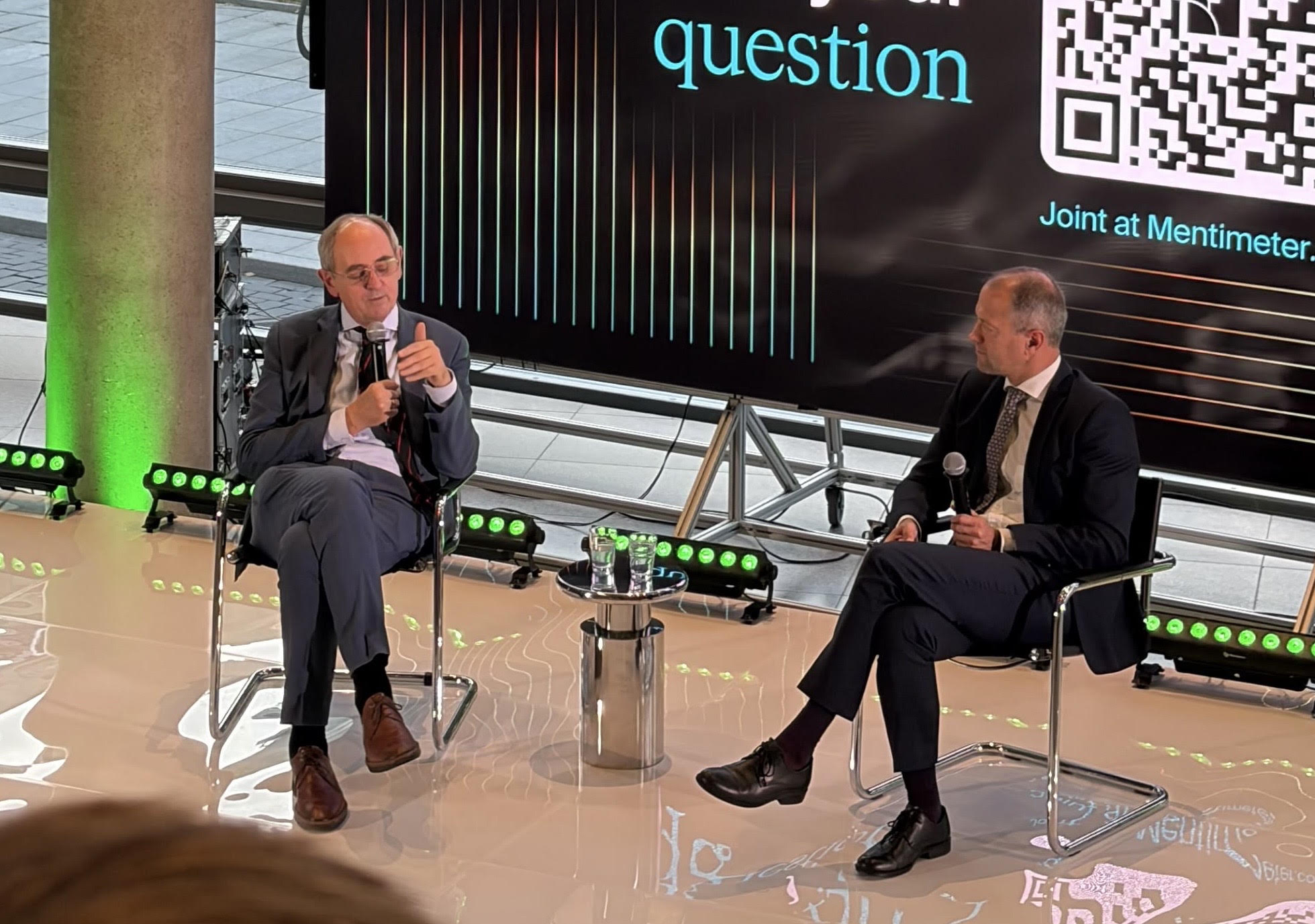
On September 28, 2026, at ISM University of Management and Economics in Vilnius, British journalist, author and founding Director of the Baltic International Security Centre Edward Lucas joined President of ISM University Professor Dalius Misiūnas in a broad discussion on what the global community can learn from the Baltic region, as well as its untapped potential.
Edward Lucas served as Moscow bureau chief for The Economist in the 1990s, at the tail end of then-President of Russia Boris Yeltsin’s presidency and the beginning of Vladimir Putin’s, when much of the world saw Russia as a great emerging market. He recalled it as a lonely time for the few journalists willing to say the country was heading toward repression at home and aggression abroad. He never believed Russia would become a large, friendly democracy, and that experience shapes the message he brings to Western audiences today.
Lucas believes that the Baltic states are not short on strength but on confidence in how they present it. Throughout the rich discussions, Lucas moved from the lessons of the 1990s to the state of European security, from capital markets to defense tech, and kept returning to a single theme: in his view, the region has a far better story than the one it is currently telling, especially Lithuania.
Perceptions of Baltic Security
The Lithuanian Prime Minister Mindaugas Sinkevičius had recently appeared on television news and, in Lucas’s words, made evacuation plans for buildings a central topic. Lucas likened it to ISM inviting him to speak by advertising its safety record: “It’s like saying, ‘Please come to ISM because we have fantastic fire safety.'” The room laughed. He was careful to say that he supports preparedness, and wishes the EU officials in Brussels had a tenth of the planning Lithuania has. He criticised what he saw as insufficient practical guidance in Brussels on keeping food, water, batteries, and medicine at home. His objection was to the order of the pitch. Evacuation plans are worth discussing as a news item, but leading with them prompts mainstream audiences to assume conflict is imminent.
Lucas argued against the “mythical invasion” narrative that suggests the Baltics are the next immediate target of Russia. He pushed back on decision-makers and media outlets for overstating the threat to the Baltics to gain attention. In his view, although Europe is finally treating Russia as a real threat, it now leans too far in the opposite direction. He argued that the media is spreading an oversimplified read of the conflict, which can harm trade, investment, and alliance cohesion.
Lucas also pointed to the Riflemen’s Union in Lithuania as a success story the country undersells. Founded in 1919, banned after the Soviet occupation in 1940, and re-established in 1989, the Union has nearly 20,000 members in Lithuania and abroad. Membership also extends to include youth education and civilian preparedness. It is a voluntary, state-supported civic organisation operating under Ministry of Defence supervision and working closely with the Lithuanian Armed Forces, combining defence and civilian resilience functions. His message to what he called the old West, essentially everywhere west of Poland, is to take note of Baltic vigilance and readiness, since much of the continent is still asleep. He would not use the Riflemen’s Union as an opening line, since it invites the question of why a country needs one at all, but in any conversation about social cohesion, national resilience, or how a society responds to security threats, it deserves a place.
Baltic Resilience: What the Old West Misses
The mainstream now agrees that Russia is a serious problem, he said, but has drawn the wrong conclusion. Because Russia is a menace, the reasoning goes, the Baltics must be next. Lucas called this a patronizing overreaction. People who could not find the region on a map a decade ago now speak with total confidence about Narva in Estonia or the Suwałki Corridor. Narva is an Estonian border city facing Russia’s Ivangorod; the Suwałki Corridor is the Polish-Lithuanian border strip between Belarus and Kaliningrad, and NATO’s only land link to the Baltic states.
Lucas argued that the real front line runs elsewhere: through Germany, where he said the Alternative für Deutschland (AfD) receives Russian backing, through France, and through Washington DC. Those are the places where Russian operations gain lasting traction. In the Baltics, they remain confined to the margins. Russia can, in his words, “beat someone up, burn something down, or send a balloon over the border, which is irritating but not systemic.” Lucas dismissed the alarmist maps flooding social media feeds that show big red arrows pointing into the Baltic states.
Lucas also reframed the question that Misiūnas said haunts the region. Where Misiūnas framed it as “not if, but when,” Lucas turned it around: “not when, but if.” He illustrated a wider habit among decision-makers overstating the danger to draw the West’s attention, extending to Kyiv. The motive is understandable, to garner more Western support for Ukraine, but it damages trade, investment, borrowing costs, and tourism.
Lithuania’s Untapped Potential
Lucas lamented a shortage of positive accounts built on facts. Lithuania, he argued, has never in its history been happier, richer, or safer. Vilnius, Lithuania’s capital, is the largest city in the Baltics, growth is strong, and young people here are among the happiest in Europe at a time when mental health problems among the young are epidemic elsewhere. Plenty of successful countries live in bad neighborhoods, he noted. South Korea trades, attracts investment, and sees its stock market boom next to North Korea, and Israel combines intellectual, cultural, and technological vitality with serious threats. Lithuania, which could fit several Israels inside its borders, has no reason to regard size or geography as destiny. The answer is confidence and data.
On branding, Lucas defended “Baltic” over “Nordic” as a label. Baltic pulls a region that many people struggle to tell apart westward, toward Sweden, Denmark, Germany, and Poland, and carries associations of prosperity, integration, and centuries of shared history. “Nordic-Baltic” in one breath links the region to Norwegians and other regional partners. Calling the Baltics Nordic, he added, takes two to tango, and the Nordic Five do not yet invite the Baltics into the room. As to what has driven Lithuanian success, he pointed to an ability to think big and to see large historical and geographical themes, a legacy of the Grand Duchy of Lithuania and the Polish-Lithuanian Commonwealth. Traveling the Baltics in 1991, he found that only in Lithuania would people say, naturally and in mid-conversation, that if you go back 600 years, things were different. He credited Vytautas Landsbergis with grasping the scale of what was happening in a way few regional leaders did.
Economic Realities: Market Integration
The conversation then turned to capital markets, where Lucas argued that reality does lag. The Baltics are classified as frontier rather than emerging markets, a label that has little to do with how risky the countries are and much more to do with how small and thinly traded their stock markets are. Turnover across Nasdaq Baltic can run to only about €5 million on a good day. The consequence, he argued, is a double tax on ordinary people. Savers earn less on their deposits than they would in Germany, and small and medium-sized businesses pay more to borrow. Moving out of the frontier category would attract significant index fund investment.
Lucas also pointed to borrowing costs as a measure of how much geopolitical risk international financial markets attach to a country, and he quizzed the audience on which countries borrow at the same rate as Lithuania. Finally, he noted that foreign investment in Lithuania, including both new projects and acquisitions of existing businesses, has been higher in the four years since the full-scale invasion of Ukraine than in the four years before it.
Lucas sees two ways out. The first is a catapult into the emerging market category, which would take six major listings: two unicorns, two state-owned enterprises, and two foreign investors. With them, he said, the Nasdaq would become investable for index funds, drawing perhaps €300–400 million into the Baltic exchange. It needs only Baltic cooperation and public-private coordination: three finance ministers sitting down with the region’s banks, the unicorns, and the state-owned railways and energy companies. He could imagine it done in an afternoon, though he is not sure it will happen. The second is the Swedish idea of a Nordic-Baltic capital markets union, which looks excellent on paper, although he wondered how Lithuanian and Estonian governments would feel about ceding control of their banking systems. Newer fintech routes, such as crowdfunding, may also help. Misiūnas observed that this called for more big-picture thinking and less evacuation thinking. Lucas’s reply: “It’s not complicated, it’s just difficult.”
Strategic Communication and Narrative Control
Lucas spent part of the evening on what he was doing about the communications problem. The think tank he launched in June set its first goal as a pan-Baltic event at the NATO summit in Ankara, Türkiye. Despite membership since 2004, the three states had never held a joint Baltic three (B3) event with senior figures from each country on the main stage in prime time. The panel, titled “Why Narva’s Not Next: Checking Assumptions on Baltic Vulnerability”, made the case that Narva or Suwałki are not next and that the region does things the West should copy. Attendees, he recalled, came up afterward saying they had no idea these countries did so much. He found that annoying, since people at a NATO summit should know already. The Munich Security Conference is next. His measure of success would be for organizers to think of the Baltics automatically when planning sessions on AI, Chinese technology, or supply chains, so that the pitch is no longer necessary.
Defense integration, he argued, is the place to begin. Sweden’s eastern defense perimeter now effectively sits on the Baltic-Russian frontier, and he has been promoting Amber Dome, an integrated Nordic-Baltic air defense system. The Baltics cannot afford adequate air defense alone, but wealthy partners cannot be safe without sensors and shooters on Baltic soil. The arrangement already exists in part, since Baltic radars serve as the eyes and ears of the Nordics. The main weakness, he argued, is a convoluted command structure, with responsibility spread across distant commands. He called that mainly a NATO problem, not a Baltic one.
On NATO’s future, he offered historical perspective. He recalled anxieties in the 1970s about the credibility of the American deterrent, the clash over nuclear weapons with the European peace movement in the 1980s, and American withdrawals in the 1990s. He recalled asking Bill Clinton in Riga, Latvia, in 1994 what would happen if Yeltsin did not last, and getting a hesitant answer. Europeans, he concluded, have always needed to do more, and they now are. The European pillar of NATO has never been stronger, though not yet strong enough, and he wanted the Joint Expeditionary Force to expand into new domains and perhaps new members, including Poland and eventually Ukraine. His metaphor was that of keeping your trousers up: a belt, suspenders, and well-tailored trousers that stay up on their own. Baltic security rests on several such layers, including local readiness, early deterrence, regional arrangements with Poland and Germany, and returning American forces. For Russia to attack, every one of them must fail at once.
The Baltic Barometer is the Baltic International Security Centre’s flagship report, published regularly. Defense tech, the subject of an upcoming edition, is the clearest example of the region’s upside. Ukrainians trust the Baltics and share technology with Estonian and Lithuanian companies in a way they do not with others, in part because there is no fear of larger competitors stealing or killing it. The second advantage is the feedback loop. Testing that takes six to nine months in the West takes six to nine days on Ukraine’s front lines, a financial advantage that comes at a human cost Lucas did not play down. A growing cluster of companies across the region is already benefiting, and he expects it to become a major story.
All of it comes back to message discipline. Lucas advised telling a positive story built on data, and the region has strong examples to draw on, including its record on foreign investment. Vinted, the Vilnius-founded resale marketplace, was valued at €8 billion in 2026 and reported €62 million in net profit on €1.1 billion in revenue for 2025. Leading with evacuation plans, by contrast, makes a country sound like a place to flee. A unified, fact-based narrative would tell investors and allies that the Baltics are building, not merely bracing for crisis. Lucas’s conclusion is unambiguous: Lithuania and the Baltic region as a whole have every reason to start sharing this story with the global community.
The views and assessments presented in this briefing are those of the speakers and do not necessarily reflect those of Tessera Institute for Global Affairs.