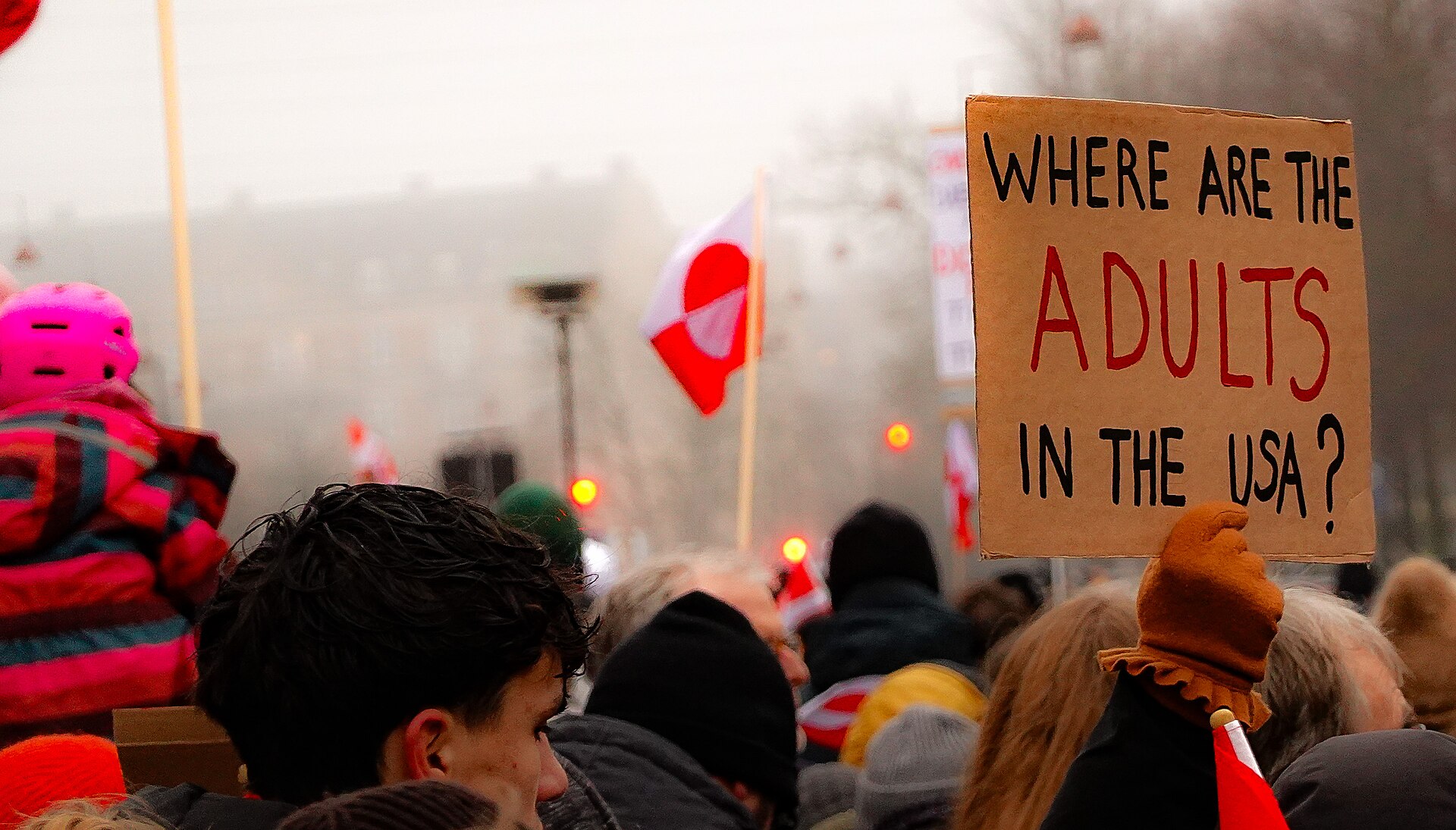
Photo by Jens Cederskjold / CC BY 4.0.
Noa Evers, Research Fellow
Greenland’s growing geopolitical significance has brought renewed US interest, creating security concerns that extend beyond territorial acquisition to attempts to influence Greenlandic political and social affairs. This analysis argues that pressures from foreign influences in Greenland cannot be separated from the colonial history that continues to shape the relationship between Greenland and Denmark, as unresolved colonial legacies continue to affect identity, trust and ontological security. This policy analysis argues for a broader approach to Danish security policy in the Arctic, complementing military defence with reconciliation measures and initiatives that strengthen the relationship between Greenland and Denmark.
Greenland is becoming an increasingly contested political space. US interest has been expressed not only through President Donald Trump’s repeated calls to acquire Greenland, but also through on-the-ground economic and political engagement. This once again dominated Danish and Greenlandic news outlets in July, when an American oil company with suspected ties to the Trump administration sent drilling equipment to East Greenland without permission, prompting a “strong warning” from Greenlandic authorities. Attempts to increase American influence on the island is not a new development, as only a year ago American citizens conducted covert activities in Greenland, illustrating the increasingly demanding nature of this engagement. It therefore did not come as a surprise when Denmark introduced two new defence agreements in collaboration with the Greenlandic and Faroese governments in 2025, with acquisitions totaling DKK 27.4 billion (€3.67 billion).
Alongside military investments, the Danish state has increasingly invested in reconciliation initiatives addressing the colonial relationship between Greenland and Denmark. These include the establishment of a joint research commission to study the shared history between the two countries, as well as more recent developments, such as Danish Prime Minister Mette Frederiksen’s formal apology to Greenlandic women subjected to the so-called spiral campaign between 1966 and 1970, during which approximately 4,500 IUDs were inserted without informed consent.
This policy analysis argues that Danish reconciliation measures should be understood not only as efforts to address historical injustice, but also within the broader context of preventative security policy. In a Greenland increasingly shaped by geopolitical tensions, addressing colonial legacies can create conditions for greater ontological security and political resilience. Moreover, this should not be viewed as an attempt to trivialise the importance of military defence, but to argue for a more holistic approach to Arctic security; one that more extensively addresses threats to human security and the historical conditions that shape Greenlandic agency.
Greenland’s Security Challenge: Beyond Territorial Control
In January 2026, the crisis surrounding American interest in Greenland escalated again. This time raising serious concerns that the US might seek to take control of the territory and further straining the NATO alliance that has long served as a foundation for peace and stability. Since his first election in 2019, Donald Trump has repeatedly expressed interest in acquiring the territory, making Greenland’s territorial sovereignty an increasingly prominent geopolitical issue. The country’s strategic Arctic location, proximity to North America, and access to important current and potential shipping routes further underscore its geopolitical significance. However, while attention has largely focused on the territorial threat posed by the US, this risks overlooking a more gradual form of geopolitical pressure that has become increasingly visible in recent years: attempts to influence the political and social environment in which Greenland determines its future. This became particularly visible in 2025, when Denmark summoned the US chargé d’affaires after reports said American citizens were conducting covert activities in Greenland. According to Danish media reports, sources described the alleged objective as infiltrating Greenlandic society and promoting Greenland’s separation from Denmark and closer alignment with the US. One individual was reportedly collecting the names of Greenlanders interested in Donald Trump’s plans of purchasing the island. However, the identities and affiliations of those involved remain unclear and the US government did not confirm that an organised influence campaign was underway. A White House official instead told reporters that Denmark should “calm down,” while the US State Department stated that it could not comment on the actions of private US citizens. Danish Foreign Minister Lars Løkke Rasmussen nevertheless described attempts to interfere in the kingdom’s internal affairs as “unacceptable,” while Danish intelligence warned that various influence campaigns were targeting Greenland.
However, the topic of Greenland’s separation from Denmark, accentuated by American interests, is not new. Independence is and long has been a legitimate and important part of political and social debate in Greenland. However, it becomes part of a broader security concern when external actors attempt to amplify existing divisions for their own benefit. For that reason, it is important to view US attempts to infiltrate the political debate over Greenlandic sovereignty within the context of the colonial histories which continue to shape the island’s identity and political agency.
From Colonial Trauma to Ontological Insecurity
More than three centuries of Danish colonial rule and the continuing constitutional relationship between the two countries shape Greenland’s political environment. Colonial rule transformed Greenlandic political institutions, social structures, and cultural practices, placing political authority within a system largely defined by Danish standards. In addition to drastically altering the way in which society functions, colonial practices also disrupted the sense of political and cultural continuity through which nations create their collective identities. Precolonial Greenlandic society was characterized by what Karla Jessen Williamson refers to as the notion of genderlessness (2011), where power and authority were not directly related to binary gender divisions. Danish colonial rule drastically altered the relationship between gender and labour through the introduction of Christianity (1988), with a focus on the man as the hunter and provider while the woman’s primary function was that of a caretaker. The household was transformed into an economic and social unit, and a native elite was established, inspired by Danish understandings of status and prestige. Societal transformations increased rapidly with the modernization policies of the 1950s and 1960s, characterized by industrialization and increasing gendered divisions in the labour market. The rapid transformation of Greenland’s economic, political, and social structures, alongside processes of cultural assimilation, also referred to as the Danification of Greenland, significantly altered the relationship between the two countries. Greenland’s collective identity has therefore developed alongside a tension between Indigenous culture partially lost to colonisation, and elements of the modern nation-state imposed by Danish rule (Rud, 2017).
Besides the more visible consequences of colonization, memories and trauma related to colonial histories can also continue to affect ontological security (Innes & Steele, 2013). This refers to a relatively stable sense of identity and continuity: an understanding of who one is, where one comes from, and how one relates to the surrounding world. Political communities construct such continuity partly through biographical narratives about their past, present, and future, which provide meaning and set expectations for political relationships. Academics argue that trauma can serve as a way to disrupt and manipulate this sense of Self, as traumatic events can either destabilise and upset a nation’s view of itself, or become formative of a nation’s collective memory. The latter is also referred to as the ‘walk through blood’ (Smith, 2000); trauma related to a fight for independence. Although Greenland transitioned to Home Rule in 1953 and Self-Government in 2009, it remains part of the Danish kingdom, with the question of independence still central to Greenlandic political life. A 2017 poll found that 56% of the Greenlandic population, consisting of 55,860 people by early 2017, supports independence. This highlights the continuous tension between Greenland’s constitutional status and its aspirations for greater political autonomy.
Greenland can therefore be understood as a ‘transitional society’: a postcolonial society emerging from a history of systematic and structural violence accompanied by political uncertainty in which the “shape of the new institutional dispensation is up for grabs by incumbent and opposition contenders” (Esquith, 2018, p. 283). While colonial trauma does not solely determine Greenland’s political future, academic debate reflects that Greenlandic identity politics still largely revolves around two simultaneous processes connected to its colonial history: a decline of traditional Indigenous culture and the process of modernisation (Gad, 2009). The concept of ontological security provides a useful lens for understanding how Greenland, where questions of identity and political belonging remain closely tied to its colonial past and which currently finds itself in a space of ‘becoming’, can be vulnerable to external influences. External actors do not necessarily need to create entirely new political divisions; they can instead exploit existing narratives and divisions. This is particularly evident in recent US rhetoric, including Vice President JD Vance’s criticism of Denmark, stating that they “have not done a good job by the people of Greenland.”
Securing Agency Through Reconciliation
Moving on to Danish-Greenlandic reconciliation initiatives, these should first and foremost be understood as important responses to historical injustice. The Danish state’s acknowledgment of abuses committed against Greenlanders, including Danish Prime Minister Mette Frederiksen’s 2025 apology to Greenlandic women subjected to the spiral campaign, reflects a growing recognition in Danish society of the disastrous consequences of colonialism. However, in the Greenlandic context, reconciliation has implications that extend beyond historical justice to questions of security and political resilience. By establishing a shared factual basis for confronting the colonial past and acknowledging Danish responsibility for historical wrongs, reconciliation can contribute to greater political legitimacy and potentially strengthen the conditions for increasing ontological security. Recognition matters, as unresolved or, in some cases, even denied historical experiences can sustain trauma and lack of trust in the other. I believe this is particularly relevant in the case of Danish colonial history, as a poll from 2025 shows that only 25,8% of Danes believe Denmark has treated Greenland unfairly. Additionally, after an attempt was made by the Greenlandic government to establish a reconciliation commission in 2013, former Danish prime minister Helle Thorning-Schmidt denied the invitation to participate, stating that “we have no need for reconciliation”. Denmark’s denial of its own colonial past therefore presented a major challenge to any reconciliation attempts in the past. However, as stated in the coalition agreement of the Greenlandic government elected in 2013, “to distance ourselves from the colonisation of our country, it is necessary for reconciliation and forgiveness to take place” (Grønlands Forsoningskommission, 2017, p. 9, own translation) and thus, the process of reconciliation needs to start somewhere, and perhaps now is the time.
Beyond Military Security
This analysis concludes that an effective security approach in Greenland must also address the societal dimensions of security related to its colonial past. As ongoing American attempts to influence Greenlandic political debate show, military preparedness alone cannot address all Arctic vulnerabilities. For Danish and Greenlandic security policy, this means complementing military capabilities with state funding aimed at advancing reconciliation, opening up the debate in society regarding Danish colonial history, and strengthening trust and cooperation, while ensuring that Greenlanders retain the agency to determine their own political future.
Recent polls show that only 8% of the Greenlandic population believes it would benefit from becoming part of the US, but reconciliation attempts can nevertheless address underlying conditions that may make Greenland more vulnerable to external influence. While it would be naïve to assume that reconciliation will automatically eliminate societal divisions, it can contribute to establishing a relationship between Denmark and Greenland which is responsive to Greenlandic concerns. A resilient and secure Greenland is not necessarily one that remains within the Danish Kingdom, but one in which Greenlanders are able to determine their own political future without coercion, manipulation or external influence. Reconciliation should therefore be understood not as a means of securing Danish sovereignty, but as a space through which colonial traumas and legacies are addressed while simultaneously strengthening Greenland’s political agency.
References:
Dybbroe, S. (1988). Participation and control: Issues in the debate on women and development – A Greenlandic example. Folk, Vol. 30, 111–132.
Esquith, S. L. (2018). Security: Building security through peace and reconciliation. In Routledge Handbook of Development Ethics (1st ed., pp. 281–296). Routledge. https://www.taylorfrancis.com/chapters/oa-edit/10.4324/9781315626796-31/security-stephen-esquith
Gad, U. P. (2009). Post-colonial identity in Greenland? When the empire dichotomizes back – bring politics back in. Journal of Language and Politics. https://vbn.aau.dk/ws/portalfiles/portal/236679920/2009b_Gad_JLP_8_1_136_158_Post_colonial_Identity_in_Greenland_FINAL_DRAFT.pdf
Grønlands Forsoningskommission. (2017). Vi forstår fortiden, Vi tager ansvar for nutiden, Vi arbejder sammen for en bedre fremtid. Retrieved October 8, 2026, from https://www.ft.dk/samling/20171/almdel/GRU/bilag/16/1832977.pdf
Innes, A. J., & Steele, B. J. (2013). Memory, trauma and ontological security. In UEA Digital Repository (University of East Anglia). https://ueaeprints.uea.ac.uk/id/eprint/47560/
Rud, S. (2017). Toward a Postcolonial Greenland: Culture, Identity, and Colonial Legacy. Colonialism in Greenland. Cambridge Imperial and Post-Colonial Studies Series. Palgrave Macmillan, Cham. https://doi.org/10.1007/978-3-319-46158-8_7
Smith, D. (2000). Ethical Uncertainties of Nationalism. Journal of Peace Research, 37(4), 489–502. http://www.jstor.org/stable/424643
Williamson, K. J. (2011). Inherit my heaven: Kalaallit gender relations (1st ed.). Naalakkersuisut.