
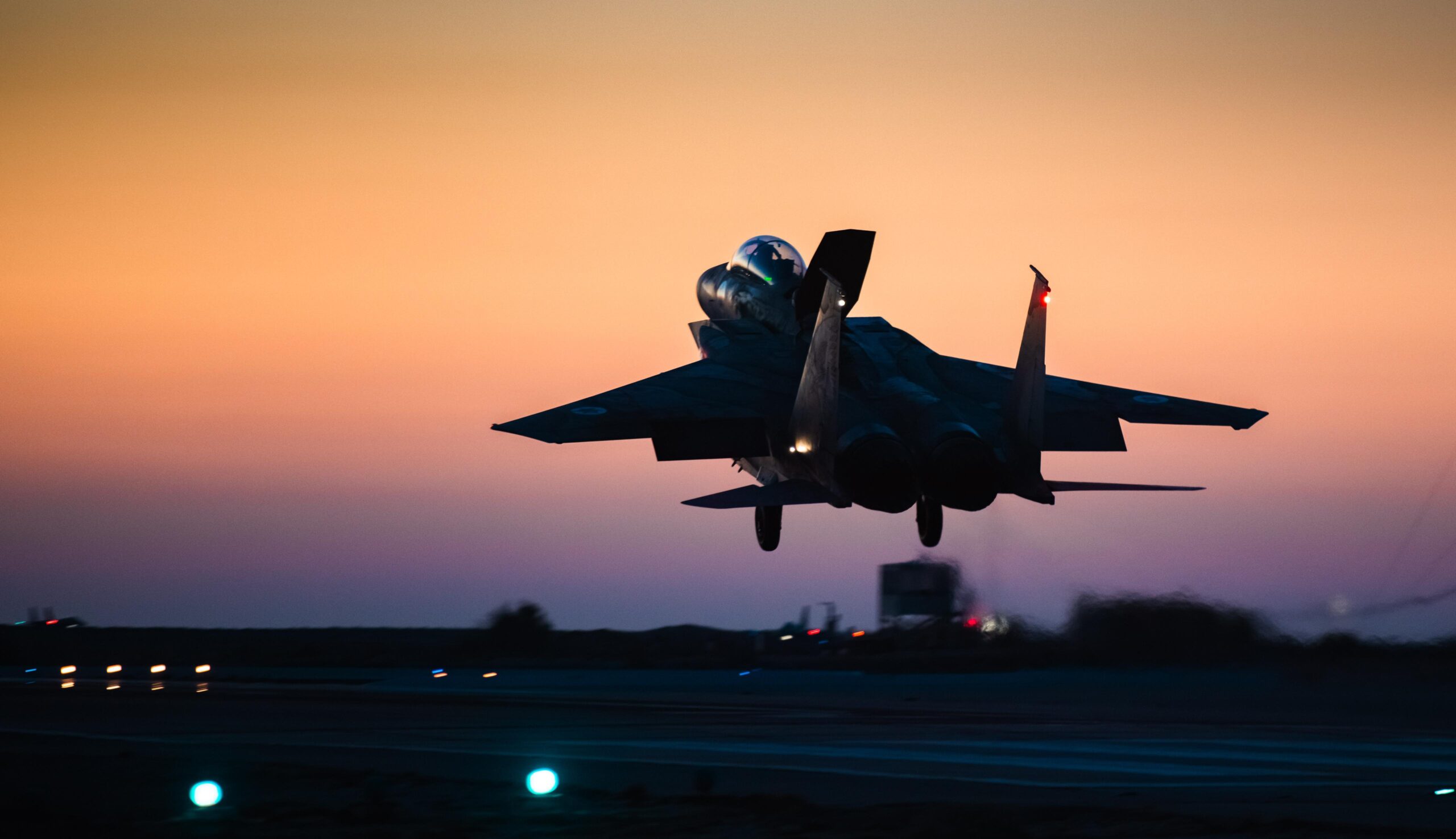
An Israeli F-15I takes off in an image released in connection with Operation New Order, September 2024. Photo: IDF Spokesperson’s Unit, via Wikimedia Commons, CC BY-SA 3.0.
By: Jacob Hoffman, Research Fellow
The most recent war between Israel and Hezbollah (2023-present) that has burned across Southern Lebanon is far from isolated to those hills and valleys, as both combatants project their propaganda narratives across the globe. A principal feature of those digital narrative systems, which take many propaganda forms, is combat footage, used by both sides to amplify their existing narratives while also extolling themes of military success and ideological legitimacy, portraying themselves to supporters and allies as the first line of defense in a civilizational struggle against an existential enemy. For Israel, combat footage serves to bolster Israeli narratives that their foes are illegitimate criminal terrorists at war with Western Civilization, a struggle the IDF seeks to portray itself as at the forefront of. In Hezbollah’s case, combat footage highlights the tenacity of Hezbollah resistance to Israeli, and by extension American, aggression, using real images of destruction to showcase the undiminished capacity of Hezbollah to make successful breaches of the Israeli military despite setbacks and disadvantages, while also using imagery of destruction to laud the sacrifice of those martyred in this struggle.
Israel
Israel has long maintained it serves as the foremost bulwark of what is a collective struggle against Islamic fanaticism and terrorism for not just the Middle East, not even just Western Civilization, but the entire world, depending on the audience they are attempting to reach. The Prime Minister of Israel Benjamin Netanyahu has deftly framed Israeli narratives to different audiences, each making appeals to the overall goal of keeping Israel from being diplomatically isolated in the face of growing controversy and opposition to its conduct across the Middle East. As Ihsan Yilmaz and Nicholas Morieson of the European Center for Populism Studies described in their article “Nationalism, Religion, and Archaeology: The Civilizational Populism of Benjamin Netanyahu and Likud”, “Israel, [Netanyahu] argues, is a protective wall that defends Western civilization from Muslim barbarians who wish to destroy it; on this basis, Netanyahu calls for Europeans and North Americans to support Israel in its battle for civilization and against the forces of barbarism.”
On September 15, 2025, in a joint press conference with US Secretary of State Marco Rubio, Netanyahu explicitly framed Israel as an extension of the United States’ values and even its very existence in the Middle East, appealing to the democratic values of American audiences.
Netanyahu began by saying, “We stand in a time of immense challenges, the aggression of Iran and its terrorist proxies, those who chant, ‘Death to America, death to Israel.’ And they are not chanting it by accident because they see Israel as the front line of American civilization here in the Middle East,” implicitly and explicitly tying American and Israeli civilizations together. Later, answering a question about the murder of American activist Charlie Kirk days earlier, the Israeli Prime Minister asked, “How do you actually address these threats, from the poisonous incitement of the people who don’t believe in free speech, who believe in the imposition of their views on others, who speak of democracy but actually want to trample democracy into the dust. How do you deal with that?” Once again, Netanyahu frames a threat to Israeli democracy as a threat to American democracy. The answer to these threats, Netanyahu posits, is a collective response from what he consciously frames as “Western” civilization. “I think it’s common cause. I think the world – right now, the Western world, America, Israel are being challenged by extraordinary violence from their political opponents within their countries, extraordinary violence.”
In the opening weeks of the war against Iran, Netanyahu provided a summary of the course of the war, and again laid out his vision of Israel’s position very clearly, this time appealing to the Middle East and the entire world as being protected by Israeli and American action in the war.
“Under President Trump’s visionary leadership, America and Israel are acting together in Iran with great determination and unprecedented strength. Operation [Roaring] Lion is designed to remove the existential threats posed by the Ayatollah regime, the regime that has waged war against America and Israel and the people of Iran for 47 years,” according to the Israeli PM. The “Ayatollah regime,” as Netanyahu frames the Islamic Republic of Iran, poses a threat to both Israel and the United States, but also to Western Civilization and the entire world. “Today, the Ayatollah regime is not only attacking America, is not only attacking Israel, not only attacking the Iranian people, it is attacking the entire Middle East and beyond,” Netanyahu claimed. “They’ve attacked civilians and Americans and American assets in Iraq, Kuwait, Saudi Arabia, Bahrain, Qatar, UAE, Oman, and they’ve even attacked, through their proxies, Cyprus and Europe.”
Netanyahu then makes a direct appeal to Western Civilization, and to American losses across the Middle East, as reason to support Israeli and American actions against the Iranian government. “And these ideological fanatics, these lunatics, they find their raison d’être, their reason for being, is wiping out Western civilization and America that leads it. They have claimed the lives, they’ve maimed and wounded, thousands of Americans in Iraq and Afghanistan. They killed the American Marines in Beirut. They bombed your embassies. They tried to assassinate the American president, Donald Trump, not once but twice. Now they blackmail for oil.” Here, Israeli enemies are collectively described as American, Western, and even global enemies, and are delegitimized as murderous, criminal thugs who attack civilians, with groups like Hezbollah further delegitimized as mere extensions of Iran rather than authentically representing any opposition to Israel in Lebanon.
In support of these narratives, Israel employs a great array of digital media strategies, with one of the most notable being combat footage, especially that of drone footage and missile strikes. This footage is often accompanied by detailed explanations of their targets, displaying the threat that the target posed to Israeli civilians or their criminal attacks against Israel, including participating in October 7th or violating the ceasefire, as well as portraying the IDF as a decisive but surgical force that is carefully dismantling criminal terrorist networks, not indiscriminately attacking civilians.
In a September 1, 2026, post, the IDF further detailed the justification for their operations in Lebanon as well as their claims to Hezbollah’s concealment of weaponry amongst civilian infrastructure. “During the [IDF] troops’ operations,” the post reads, “combat equipment and weapons were located, including guided anti-tank missiles, a rocket launcher, missile launchers, grenades, explosive devices, Kalashnikov rifles, tactical vests, uniforms, and helmets,” highlighting the aggressive material of Hezbollah. But most notably, the IDF claims this was found hidden amongst non-combatant locations, writing, “terrorist infrastructure belonging to Hezbollah was found embedded within civilian infrastructure, as is Hezbollah’s modus operandi, and was dismantled by the troops.” The post concluded, “the IDF will not allow the Hezbollah terrorist organization to harm Israeli civilians or IDF troops, and will continue operating to remove threats while remaining committed to the ceasefire agreement,” with an accompanying video of Israeli forces patrolling through Lebanon. Here, the IDF is once again stressing the aggressive threat that Hezbollah represents, as well as their use of civilian infrastructure to hide their weaponry they intend to use against innocent civilians, in contrast with the IDF, portrayed as operating professionally in reaction to deadly terrorist warmongering. In another example of the IDF’s alleged precise, professional temperance, a September 7, 2026, video from Gaza portrays an Israeli munition purposefully diverted at the last minute because of the presence of civilians, once again attempting to show the world that Israel’s military is careful and not engaging in wanton destruction, that they are only targeting dangerous terrorists who threaten civilians and peace in the region.
In an August 27, 2026, post, the IDF provides aerial footage of an Israeli missile strike on alleged Hezbollah infrastructure in Southern Lebanon. The footage shows a series of explosions as from Israeli missiles, as well as what are claimed to be “secondary explosions,” often used as evidence that weaponry was hit and subsequently exploded, accompanied by text claiming the strike was, “in response to the launch of explosive drones toward IDF soldiers in the Security Zone,” and that, “as part of the strikes, the IDF struck Hezbollah weapon storage facilities that were established in order to harm Israeli civilians and IDF soldiers.” Once again, Israel is portraying their operations as careful, limited, and precise, as well as being totally reactive to terrorist activity that was aimed at civilians. Thus these attacks are necessary protective actions aimed at keeping citizens and the frontline soldiers of Western democracy safe from illegitimate terrorist activity.
This footage harmonizes with portrayals of the IDF’s strikes on Iranian targets during the opening days of war. In a March 11, 2026, post, the IDF Telegram displayed a short montage of IRGC members being killed by what are described as quick, highly precise missile strikes. The footage casts the IDF as at a massive military advantage, with images of Iranian officials walking around before being engulfed in massive explosions, with the post describing these strikes as, “Within seconds of the identification, the jets struck and eliminated the operatives.” In addition, the targets were delegitimized as nefarious criminals, operatives of “the Iranian terror regime,” members of the Iranian Ministry of Intelligence that, “monitor the activities of Iranian citizens,” and, “enable the violent suppression of protests over the years.”
Hezbollah
Hezbollah makes use of both highly edited, social-media-friendly footage of successful drone strikes on IDF positions and operatives, as well as footage displaying the wanton destruction of IDF strikes on Lebanon.
Examining the propaganda narratives of Hezbollah since their war with Israel began in 2023, the Israeli think tank the International Institute for Counter-Terrorism described the importance of social media to the dissemination of that propaganda. “Hezbollah’s strategic use of media, particularly social media platforms, is central to its efforts to affect public opinion, gain support and conduct psychological warfare,” authors Daniel Haberfeld and Eitan Azani wrote, “the organization’s Media Unit plays a pivotal role in producing and disseminating tailored content across multiple platforms, including television, radio, and social media, effectively aligning public narratives with Hezbollah’s broader objectives.”
These broader objectives come in many forms, including, “campaigns [that] revolve around recurring themes such as martyrdom, resistance, religious legitimacy, psychological warfare and—since October 2023—increasing emphasis on regional unity, particularly within the Axis of Resistance.”
These themes can be seen throughout Hezbollah’s social media presence. For example, Hezbollah posted a lengthy video of Houthi forces in combat with Saudi-backed forces, highlighting the solidarity between the Axis of Resistance groups. More specifically, combat footage and videos of real destruction harmonize with these propaganda themes of martyrdom, resistance, and psychological warfare.
On the subject of psychological warfare, Hezbollah strikes don’t even need to display excessive gore, destruction, or confirmation of Israeli casualties, as the mere act of infiltrating Israeli air defenses is enough to highlight the efficacy of their war effort and the vulnerability of the IDF. As Francesco F. Milan described in his study of the use of drones by non-state actors, “Attacks that manage to break through the targeted country’s air defence systems (ADS) bring credit to terrorist organizations’ operational capabilities, regardless of their outcome.” For example, a May 5, 2026, post shows a long shot of a Hezbollah drone flying through the Lebanese skies towards Israeli Merkava tanks, with the drone ultimately flying into a tank with no IDF soldiers in sight. The description of the post states that, “an ‘Israeli’ Merkava tank was targeted by an offensive drone,” not even claiming that the vehicle was destroyed or even made inoperable, because the propaganda utility of the video is in its demonstration that Israeli air defenses can be bested, and that Hezbollah resistance continues to make strikes against the IDF despite claims of setbacks.
Additionally, authors Daniel Byman and Emma McCaleb at the Center for Strategic and International Studies, described in a 2023 article “Understanding Hamas’s and Hezbollah’s Uses of Information Technology,” the aims of Hezbollah’s media strategies. Byman and McCaleb noted that, “image and narrative are important parts of conflicts and rivalries in the Middle East, and Hezbollah uses technology to shape perceptions of friends and foes alike,” as, “Hezbollah devotes much of its technology use to its propaganda campaigns, which emphasize resistance, martyrdom, and military success.” Part of this includes transmitting images of IDF forces being attacked and killed, with Byman and McCaleb claiming this is done in order to negatively impact the IDF’s will to fight in Lebanon, noting how Hezbollah, “broadcasts battlefield footage of Israeli soldiers being killed and wounded, hoping to use this content to undermine Israeli morale.” Resistance to Israeli aggression is a central thematic claim made by Hezbollah propaganda, and is especially prevalent in their combat footage that displays their military forces engaging with Israeli forces, mostly through drone strikes. In an August 18, 2026, post, Hezbollah posted a highly professional montage of dozens of their drones striking Israeli targets, including Israeli tanks, trucks, weapons, and soldiers, accompanied by rousing music and even CGI renderings of their drones flying alongside hawks. This footage highlights the effectiveness of Hezbollah’s drone strikes, and the vulnerability of their Israeli opponents.
Martyrdom is also a highly prevalent feature of Hezbollah’s video propaganda network, with Hezbollah wielding a distinct but highly related form of combat footage for both international and domestic audiences. Hezbollah’s Al-Ahed English Telegram channel regularly posts videos of what it claims are Israeli strikes, attacks, and army maneuvers in Lebanon, such as a September 2, 2026, video of mass debris with the caption, “A martyr was reported in the morning ‘Israeli’ raid on the al-Ruwais neighborhood in Nabatieh, southern Lebanon,” or a September 10, 2026, post of a large explosion with the caption describing, “An ‘Israeli’ drone dropped explosive materials on homes in the town of Bani Hayyan in southern Lebanon,” or a similar video from August 17, 2026, of the sound of machine gun fire with the caption, “Video Footage of ‘Israeli’ forces carrying out a machine-gun fire operation toward the village of Haddatha in southern Lebanon this morning.” These videos, which highlight the material and human destruction of Israeli operations in Lebanon, are of a notably different production value than other Hezbollah videos. As seen by previous videos of Hezbollah drone strikes, which feature high production value, meticulous editing, and are accompanied by rousing music, Hezbollah is capable of highly curated video media. However, these videos feature much simpler, single perspective shots of what appears to be incidental, on-the-ground recordings of Israeli strikes, along with captions that emphasize that Israeli attacks are on martyred civilians and civilian infrastructure like neighborhoods, homes, and villages. Combined, this civilian-style POV and captions emphasizing civilian losses highlight Hezbollah’s claims that the IDF illegitimately targets non-combatants and that these losses are part of a wider, national struggle against Israel for which the slain civilians are tragic, but revered martyrs.
In her chapter for The Israeli-Palestinian Conflict in the Age of Social Media and Artificial Intelligence, “How IDF TikTok Videos Aestheticize War into Entertainment after October 7, 2023,” Carolin Constanze Melz highlights the dangers of normalizing images of death and destruction under the guise of normal internet videos. “In the digital age, war extends beyond the battlefield— it is staged, performed, and consumed as image. Violence is mediated and aestheticized, with the Israeli occupation operating through representations as much as weapons.” She continues, “technological advances, a generation increasingly detached from death, and the continuous circulation of these videos normalize violence, rendering it distant, aestheticized, and morally muted. In today’s visual culture, the ethical significance of human life risks being replaced by irony, spectacle, and passive complicity.”
The use of combat footage is the natural conclusion to both military propaganda and digital media messaging, and in many ways is likely an inevitable innovation. Beginning with the advent of cameras light enough to carry into battle during the early 20th century, the demand for displaying a constructed form of the violence of war has haunted at the edges of every combatant’s need to make their war justified and believably winnable, or at least to keep the truth of those two factors away from their supporters’ minds. As the use of social media continues to expand and evolve and combatants across the world come to harness this technology for themselves, death and destruction will only continue to appear in our algorithms alongside and in the aesthetic of disposable internet media. In this environment, war narratives and the death of dehumanized enemies become a matter of consumption, rather than a sobering question of our values and our empathy, and risk handing the moral weight of what amount of violence is ever justified over to those who control the narrative.
Bibliography
Byman, Daniel, and McCaleb, Emma. “Understanding Hamas’s and Hezbollah’s Uses of Information Technology.” Center for Strategic and International Studies, July, 2023. https://www.jstor.org/stable/pdf/resrep52622.pdf
@C_Military1. “مشاهد تطهير وتأمين مديرية جبل حبشي ومثلث البيرين ومفرق يفرس بمحافظة تعز وطرد تحشيدات العدو السعودي منها – 12 أكتوبر 2026م [Scenes of clearing and securing Jabal Habashi district, Al-Birayn triangle, and Yafres junction in Taiz governorate, and expelling Saudi enemy reinforcements from them – October 12, 2026].” Telegram, October 12, 2026. https://t.me/C_Military1/93306
@C_Military1. “بالفيديو | سِيري عَلَى اسمِ اللَّه جودة منخفضة #أبابيل #الإعلام_الحربي [Video | Proceed in the name of God (Low quality) #Ababil #MilitaryMedia].” Telegram, August 18, 2026. https://t.me/C_Military1/92112?t=0
@Eng_ahed. “Footage from an operation by the Islamic Resistance on 28-04-2026: An “Israeli” Merkava tank was targeted by an offensive drone in Qantara, South Lebanon.” Telegram, May 5, 2026. https://t.me/Eng_ahed/83570
@Eng_ahed. “Video Footage of “Israeli” forces carrying out a machine-gun fire operation toward the village of Haddatha in southern Lebanon this morning.” Telegram, August 17, 2026. https://t.me/Eng_ahed/87343
@Eng_ahed. “BREAKING NEWS A martyr was reported in the morning “Israeli” raid on the al-Ruwais neighborhood in Nabatieh, 🇱🇧southern Lebanon.” Telegram, September 2, 2026. https://t.me/Eng_ahed/88115
@Eng_ahed. “BREAKING NEWS An “Israeli” drone dropped explosive materials on homes in the town of Bani Hayyan in southern Lebanon.” Telegram, September 10, 2026. https://t.me/Eng_ahed/88452?t=0
Haberfeld, Daniel, and Azani, Eitan. “Hezbollah on Telegram: Post-Ceasefire Media Campaigns and Narrative Shifts.” International Institute for Counter-Terrorism, June 1, 2025. https://www.jstor.org/stable/resrep71018?seq=3
@idfofficial. “IDF: WATCH: Operatives of the Iranian Regime who operated within an IRGC command center were eliminated.” Telegram, March 11, 2026. https://t.me/idfofficial/16939
@idfofficial. “IDF: Anti-tank missiles, RPG rockets, launchers, and additional Hezbollah weapons located and dismantled in the Security Zone in southern Lebanon.” Telegram, September 1, 2026. https://t.me/idfofficial/19142
@idfofficial. “IDF: In response to the launch of explosive drones toward IDF soldiers in the Security Zone: The IDF struck Hezbollah infrastructure in the Nabatieh area in Southern Lebanon.” Telegram, August 27, 2026. https://t.me/idfofficial/19124
@idfofficial. “IDF: During a strike targeting a Hamas terrorist: IDF redirects munition in real time to avoid harming civilians.” Telegram, September 7, 2026. https://t.me/idfofficial/19183
Melz, Carolin Constanze. “How IDF TikTok Videos Aestheticize War into Entertainment after October 7, 2023.” The Israeli-Palestinian Conflict in the Age of Social Media and Artificial Intelligence, ed. Innocent Chiluwa and Anna Szczepaniak-Kozak. John Wiley & Sons, Inc., 2026.
Milan, Francesco F. “Terrorist Groups, Advanced Armed Drones, and Nonstate Warfare.” Defence Studies, June, 1–15, 2026. https://www.tandfonline.com/doi/full/10.1080/14702436.2026.2678585#abstract
“Secretary of State Marco Rubio and Israeli Prime Minister Benjamin Netanyahu at a Joint Press Availability.” US Department of State. https://www.state.gov/releases/office-of-the-spokesperson/2025/09/secretary-of-state-marco-rubio-and-israeli-prime-minister-benjamin-netanyahu-at-a-joint-press-availability
Times of Israel Staff. “Netanyahu transcript: ‘We have to be more powerful than the barbarians, or they will crash our gates, destroy our societies.’” Times of Israel, March 20, 2026. https://www.timesofisrael.com/netanyahu-transcript-we-have-to-be-more-powerful-than-the-barbarians-or-they-will-crash-our-gates-destroy-our-societies/
Yilmaz, Ihsan, and Morieson, Nicholas. “Nationalism, Religion, and Archaeology: The Civilizational Populism of Benjamin Netanyahu and Likud.” European Center for Populism Studies. October 10, 2022. https://www.populismstudies.org/nationalism-religion-and-archaeology-the-civilizational-populism-of-benjamin-netanyahu-and-likud/