
By Farshid Keramat, Senior Research Fellow
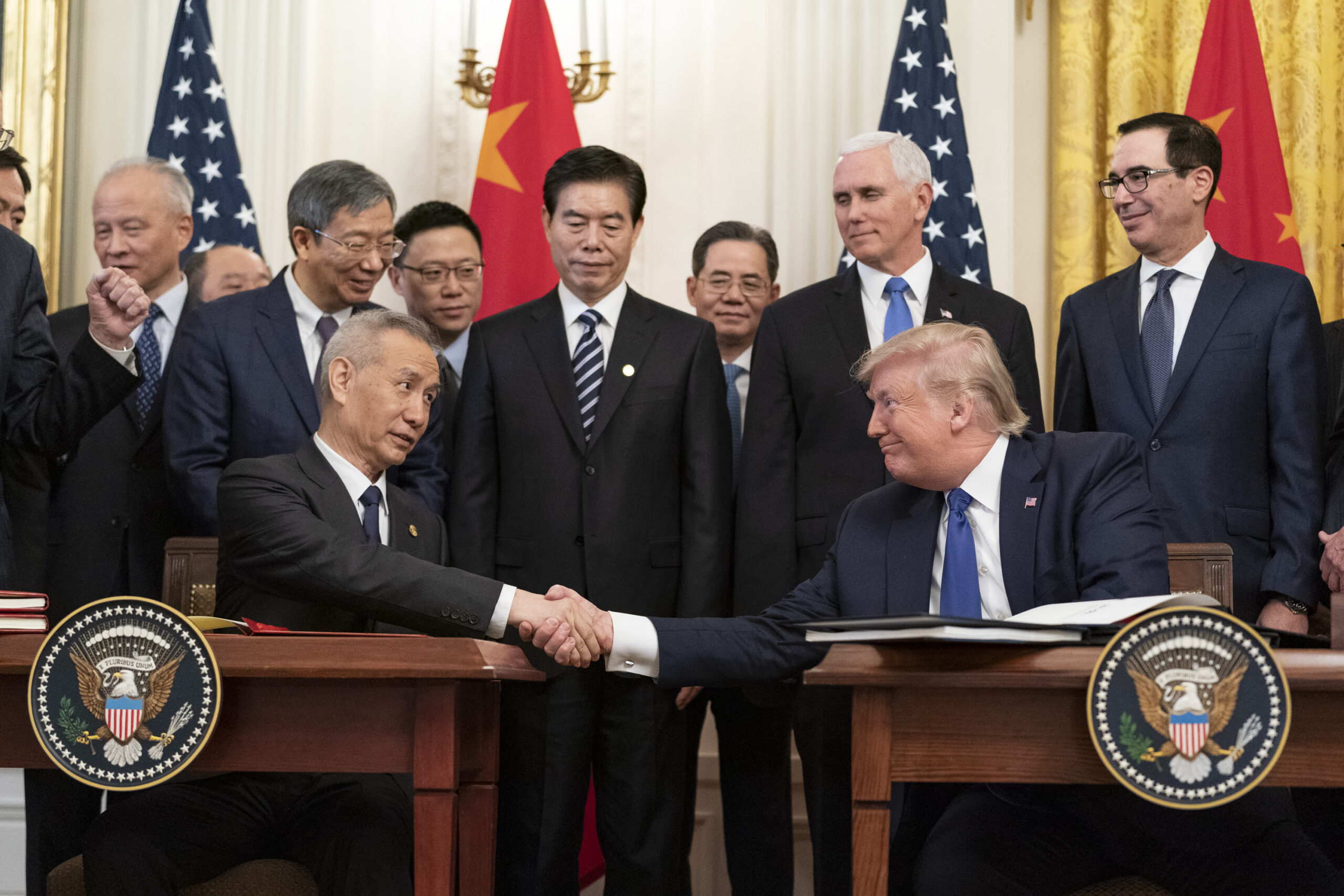
After years of tensions, the United States and China unexpectedly entered a period of truce by signing a $30 billion USD trade deal. Officially, the détente is meant to create “strategic stability” in their relationship. For middle powers like Canada, however, this alignment does not bode well. The new agreement threatens to push businesses out of large markets, exacerbate existing supply chain vulnerabilities, and erode the rules-based global trading system they depend on.
For a deal that claims strategic stability, it notably fails to resolve any of the core friction points between the two superpowers. China’s ongoing stranglehold on critical minerals directly undermines U.S. defence manufacturing. The deal also completely disregards the growing tensions over AI governance and Beijing’s lax enforcement of intellectual property rights.
A more likely motive for the collaboration is temporary economic reprieve. The U.S. is struggling with inflationary pressures ahead of a high-stakes November 2026 midterm election that could very well cost Republicans their majority in the House of Representatives and even the Senate. Washington is betting that tariff relief will ease cost-of-living pressures before voters head to the polls. China, meanwhile, is facing an economy that has lost its momentum. Despite Beijing’s stimulus spending, domestic consumption remains weak. By entering a trade agreement with the U.S., Beijing hopes to stabilize its export-focused economy without having to address difficult structural vulnerabilities at home.
The bilateral trade truce comes at the cost of middle powers like Canada. In a sluggish Chinese economy, the demand for imported goods is limited. As the U.S. gains preferential access to Chinese markets through tariff reductions and state-guaranteed purchase quotas for agriculture, forestry, and energy, Canadian products are quietly pushed out. Individually, middle powers lack the market size to protect their interests.
Canadian exporters have learned the importance of rules-based trade firsthand. In 2018, Ottawa arrested Huawei executive Meng Wanzhou under an extradition treaty with the U.S. In response, Beijing immediately restricted the import of canola seed, pork, and beef while arbitrarily detaining two Canadian citizens. When superpowers disregard multilateral frameworks, middle powers pay the price.
A consistent current in Washington’s rhetoric has been the assertion that the U.S. is disproportionately burdened by maintaining global governance structures. From allied security to the United Nations to global trade, there is a perception that it costs U.S. taxpayers without much in return. This view conveniently omits the substantial contributions middle powers are making to protect rules-based trade. Critical minerals are illustrative. Canada has committed roughly $2.8 billion USD in domestic investments. The EU is investing over $35 billion USD, while Australia has allocated approximately $4.6 billion USD in tax incentives to its mining sector. These investments directly counter Beijing’s use of export controls as leverage for its foreign policy. By sidestepping allies, the U.S. undermines free trade and isolates long-standing partners to its own detriment.
Superpower deals pose another economic threat. No longer able to hedge between the two superpowers, middle powers risk being pressured into unequal trade arrangements. Apart from reducing exports, such deals create exposure to unpredictable, unilateral policy changes in Beijing and Washington. Uncertainty inevitably suppresses domestic investment, which in turn slows down economic growth.
Waiting for Washington to change course is not the answer. Middle powers must instead aggressively pursue trade diversification. This includes strengthening and expanding regional trade agreements, like the CPTPP. It also includes advocating for regulatory harmonization between these blocs. The recently signed EU-Mercosur agreement has established the precedent. An EU-CPTPP agreement is the logical next step, albeit one that will take time to negotiate. In the short term, middle powers must double down on existing trade relations, such as Canada’s CETA and a possible associate membership status with the EU. Building a substantial rules-based global trading system independent of superpowers will allow middle powers to retain their leverage and continue to pursue economic opportunities.
This strategy will not be without pushback. A primary reason why the recent Canada–United States–Mexico Agreement talks stalled was the U.S. insisting on language that would have curtailed Canada’s ability to enter trade deals with third countries. Likewise, China is attempting to pressure middle powers through targeted export controls. Superpowers can exert leverage most strongly in bilateral relations. Their coercive power quickly dilutes when middle powers respond collectively, as they did on critical minerals.
Middle powers have relied on a U.S.-centric trade framework for many decades. Holding on to it as the sole pillar of the global trading system would be a strategic mistake. A better choice is to actively seek alternative, rules-based structures. The objective is not to abandon the U.S. market, but to establish enough alternative market access to strengthen bargaining power in dealings with Washington. This is the most likely path to securing political independence and economic prosperity.
Sources
Australian Department of Industry, Science and Resources. (2024, May 15). Announcing the 2024–25 May budget. https://www.industry.gov.au/news/announcing-2024-25-may-budget
CBC. (2022, May 19). China has lifted a 3-year ban on Canadian canola, Ottawa says. CBC. https://www.cbc.ca/news/politics/china-canada-canola-ban-ends-1.6458746
Collins, C., & Mehta, A. (2026). The state of AI global governance and its implications for the U.S.-China summit. In CSIS. https://www.csis.org/analysis/state-ai-global-governance-and-its-implications-us-china-summit
Ecomondo. (2025, April 9). Critical raw materials: EU backs 60 strategic projects. https://www.ecomondo.com/en/news-detail/critical-raw-materials-eu-backs-60-strategic-projects?newsId=4191515
European Commission. (2026, April 30). The EU-Mercosur trade Agreement. https://commission.europa.eu/topics/trade/eu-mercosur-trade-agreement_en
Government of Canada. (2022, December 9). Minister Wilkinson Releases Canada’s $3.8-billion Critical Minerals Strategy to Seize Generational Opportunity for Clean, Inclusive Growth. https://www.canada.ca/en/natural-resources-canada/news/2022/12/minister-wilkinson-releases-canadas-38-billion-critical-minerals-strategy-to-seize-generational-opportunity-for-clean-inclusive-growth.html
Le Billon, P., & Deberdt, R. (2026, March 4). Critical minerals strategy risks shifting reliance from China to U.S. Policy Options. https://policyoptions.irpp.org/2026/03/critical-minerals-us/
Llu, J. (2026, October 18). China economy grows thanks to AI export boom but domestic slump remains a drag. CNN. https://www.cnn.com/2026/10/18/economy/china-q3-gdp-intl-hnk
Lowman, H. (2026, August 28). Canada already traded away its ‘sovereignty’ with CUSMA. The Hub. https://thehub.ca/2026/08/28/canada-already-traded-away-its-sovereignty-with-cusma/
Office of the United States Trade Representative. (2026, April 30). USTR releases 2026 Special 301 Report on Intellectual Property Protection and Enforcement. United States Trade Representative. https://ustr.gov/about/policy-offices/press-office/press-releases/2026/april/ustr-releases-2026-special-301-report-intellectual-property-protection-and-enforcement
Paas-Lang, C. (2021, September 25). Michael Kovrig and Michael Spavor arrive in Canada after nearly 3-year detention in China. CBC. https://www.cbc.ca/news/politics/spavor-kovrig-in-canada-1.6189640
The White House. (2026, September 26). Fact Sheet: President Donald J. Trump advances a fair and reciprocal relationship with China while hosting historic state visit. https://www.whitehouse.gov/fact-sheets/2026/09/fact-sheet-president-donald-j-trump-advances-a-fair-and-reciprocal-relationship-with-china-while-hosting-historic-state-visit/
U.S. Bureau of Labor Statistics. (2026, October 14). Consumer Price Index Summary. https://www.bls.gov/news.release/cpi.nr0.htm
U.S. Government Accountability Office. (2024, September 12). Critical materials are in high demand. What is DOD doing to secure the supply chain and stockpile these resources? https://www.gao.gov/blog/critical-materials-are-high-demand-what-dod-doing-secure-supply-chain-and-stockpile-these-resources