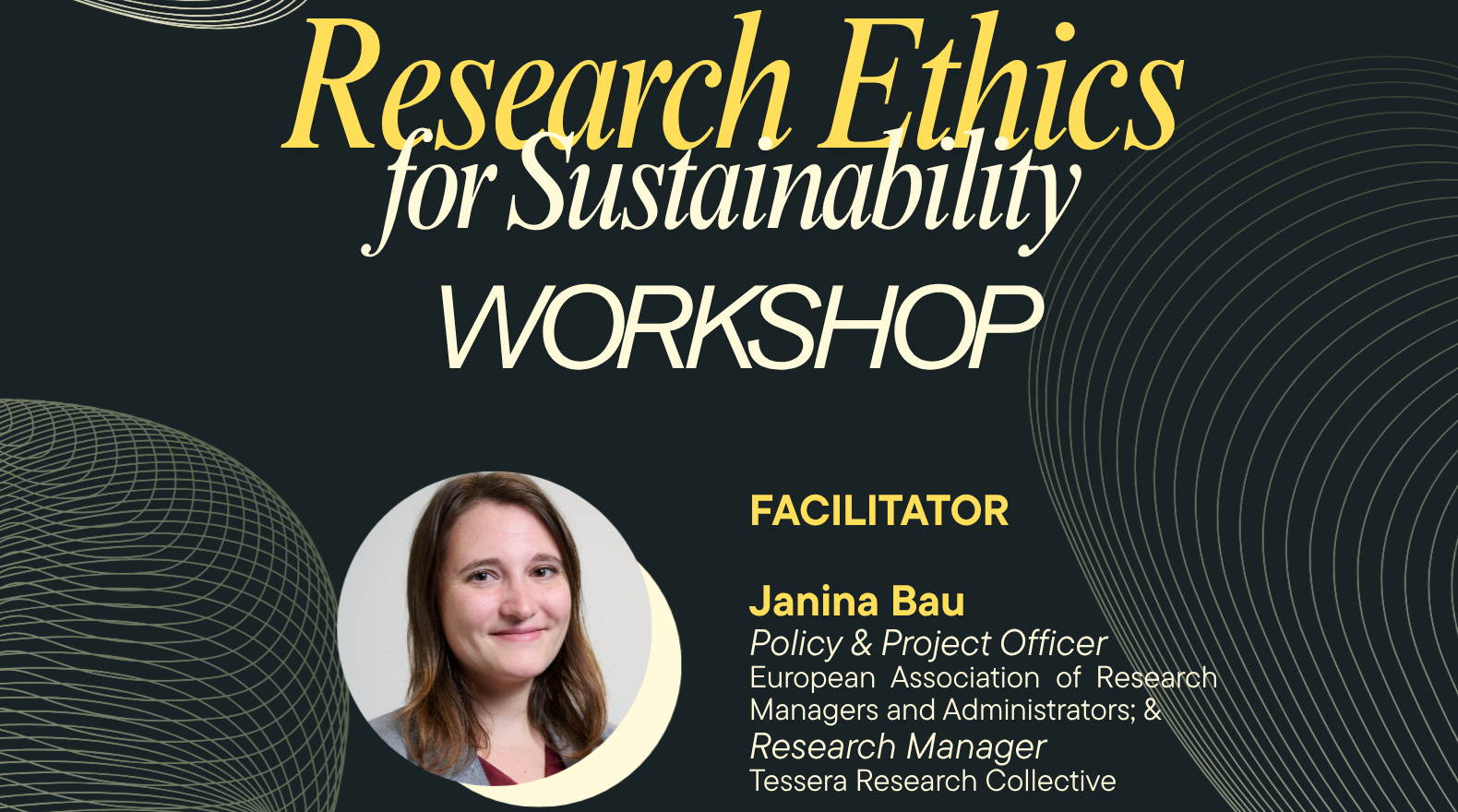
On 10 September 2026, Tessera Institute for Global Affairs hosted an online workshop on Research Ethics for Sustainability in collaboration with the European Association of Research Managers and Administrators (EARMA). The workshop was organized and led by Janina Bau, Policy and Project Officer at EARMA, and drew on training micro-modules developed through the EU-funded RE4GREEN project.
The session examined how established ethical principles, including the “Do No Significant Harm” principle, apply when environmental sustainability is incorporated into research. Through exercises on ethical principles, a “Crisis Tree” activity and a collective exercise imagining a sustainable future, participants considered how environmental challenges emerge from interconnected social, institutional and policy choices rather than from isolated decisions.
Sustainability, health and social inequality
A central conclusion of the discussion was that sustainability cannot be approached solely as an environmental matter. It is closely connected to health, social justice, access to resources and the uneven effects that research and policy decisions can have on different communities.
Participants identified a growing health crisis shaped not only by the availability of medical services, but also by social exclusion, limited health literacy and insufficient understanding of healthcare systems. When combined with existing social and economic inequalities, these factors can prevent individuals and communities from accessing services or benefiting equally from advances in healthcare.
The discussion also highlighted the position of informal caregivers supporting people involved in clinical research. These caregivers may assume substantial practical and emotional responsibilities while receiving limited formal recognition or institutional support. Their experience illustrates how research can affect a much wider group of people than those formally enrolled as participants.
Environmental justice and inclusive research
Participants connected environmental pressures directly to existing health inequalities. In the context of urban planning and rising temperatures, lower-income communities and women may face disproportionate exposure to extreme heat. This vulnerability is shaped not only by housing conditions and neighbourhood design, but also by occupational patterns and working conditions that place some groups at greater risk of heat-related illness.
The discussion therefore emphasized that environmental sustainability must include questions of distribution: who is most exposed to environmental harm, who has access to protection and whose circumstances are considered when research and public policy are designed.
Similar concerns arise within clinical and pharmaceutical research. Women and numerous ethnic groups have historically been underrepresented in clinical studies. Participants stressed that sufficiently diverse research populations are essential if findings, treatments and healthcare interventions are to serve different parts of society equitably. Inclusion is therefore not merely a question of recruitment practice, but a fundamental component of ethical and socially responsible research.
The environmental effects of research practice
The workshop also turned attention towards the environmental footprint of research itself. One example concerned the continued reliance on paper-based processes in clinical research, which can generate unnecessary waste and material consumption.
This example demonstrated how the “Do No Significant Harm” principle can be applied to routine institutional practices. Environmental responsibility should not be confined to high-level sustainability strategies or major infrastructure decisions. It should also inform the everyday organization, administration and delivery of research.
Participants further considered the role of policymakers in reducing wider environmental harms. Discussion included the carbon emissions and animal suffering associated with transporting animals from third countries into the European Union and elsewhere. Policy interventions could reduce these harms, but doing so requires environmental, economic and ethical consequences to be considered together rather than treated as separate policy domains.
Local responsibility and global coordination
The conversation also raised a difficult question of scale. Participants asked how much impact sustainability measures adopted by a comparatively small country such as Switzerland can have when environmental progress is unfolding alongside wars and other major global crises.
The discussion did not treat this as a reason for inaction. Instead, it exposed a persistent tension between the responsibility to act locally and the need for coordinated international action. National initiatives remain necessary, but their effects are constrained when environmental risks, production systems and resource inequalities extend across borders.
Participants also emphasized the importance of examining the long-term consequences of major engineering and development decisions. Such decisions can transform natural environments, shape conditions for future generations and reinforce the unequal distribution of resources worldwide. Ethical assessment must therefore look beyond immediate technical feasibility or economic benefit.
A horizontal model of sustainability
When invited to imagine a sustainable future, participants described a model that should be horizontal rather than vertical. Sustainability should not simply be imposed from above. It should be developed with people and communities, allowing those affected by research and policy decisions to participate meaningfully in shaping them.
People were consequently identified as the principal actors in sustainable transformation. Responsible policymaking, research and technology can create enabling conditions, but they cannot replace human judgement, values and collective action. Technology was viewed as a supporting tool rather than the central agent of change.
The workshop concluded that a sustainable future requires more inclusive research, accessible healthcare, stronger health literacy, recognition of vulnerable and overlooked groups, responsible use of resources and policy frameworks capable of supporting coordinated action. It also requires meaningful participation by the communities whose lives are affected.
For Tessera, these conclusions reinforce the importance of treating research ethics as an integral part of responsible inquiry rather than as a procedural requirement. The workshop reflects the Institute’s continuing commitment to research practices that are environmentally responsible, socially inclusive and attentive to their consequences for communities and future generations.