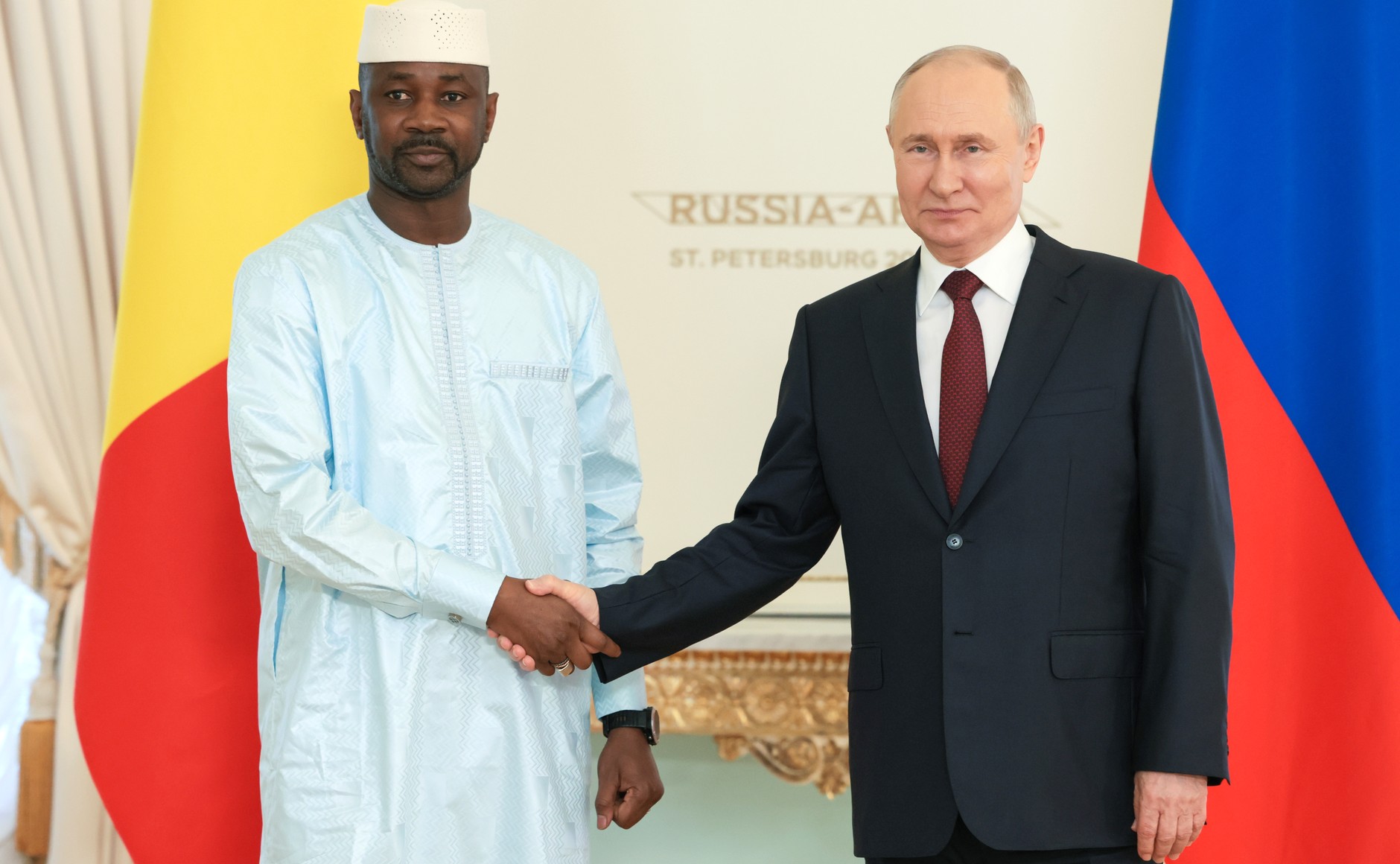
Mali’s interim president Assimi Goïta meets Russian President Vladimir Putin in St Petersburg, 29 July 2023. Photo: Kremlin.ru, CC BY 4.0.
By Shushan Grigoryan, Research Fellow
In 2013, the Malian government appealed to France for military intervention to counter terrorist actions by Al-Qaeda in the country. France deployed troops soon after, launching Operation Barkhane in collaboration with the G5 Sahel states: Burkina Faso, Chad, Mali, Mauritania, and Niger. After a period of success, measured in terms of the elimination or neutralisation of terrorist personnel and armed groups, violence linked to the activities of militant Islamic groups started to rise. Following two military coups, Mali asked France to withdraw its forces in 2022. Traditionally within France’s sphere of influence, Mali’s expulsion of French troops has been interpreted by experts and analysts as a strategic failure, regarding Barkhane as a case of counterinsurgency gone wrong. The regional security vacuum was gradually filled by a new patron: Russia. This report examines the shift from France’s security model to Russia’s, its implications for the region and, ultimately, for Europe.
Russia’s involvement in the Sahel is shaped by its conflict management strategy. In “Contesting liberal peace: Russia’s emerging model of conflict management,” David Lewis posits that Russia does not merely contest Western liberal norms, but actively promotes an alternative framework of authoritarian, or illiberal, peacebuilding. This model rests on four principles: the threat or use of force; regional diplomacy led by powerful actors capable of imposing solutions; mediation reserved for states, whose sovereignty must be respected; the containment of Western presence. In short, the framework “valorizes sovereignty and hierarchical authority over any claims to justice or human rights.” Lewis argues that Russia’s preferences exceed military strategy and carry normative and ideological implications about who comes to rule and how they affect the global order.
This perception of Russian foreign policy is also mirrored in the writings of Russian analysts and academics. A study published at Russia’s MGIMO argues that Sahelian states struggle to monopolise the use of violence and that Russian engagement seeks to curtail the capacity of non-state armed groups. In truth, only a small share of African conflicts are of a religious or ethnic nature. Most conflicts begin as skirmishes between local elites over power-sharing arrangements or control of resources near extraction sites. Rather than mediating resource distribution or facilitating dialogue between rival factions, Russia’s primary goal is supporting those states’ militaries in applying vertical coercion to stabilize their territories. As a consequence, Russian joint operations with Sahelian governments have been associated with human rights abuses such as the execution of civilians suspected of collaborating with terrorist organisations.
This Russian approach diverges from its predecessor. Whereas France’s Operation Barkhane focused heavily on air power and drone warfare, Russian forces, first through the Wagner Group and later the Africa Corps, have relied more heavily on ground operations. Yet, the differences between the French and Russian approaches extend beyond military tactics and into normative considerations regarding counterinsurgency.
Under the French, counterinsurgency became intertwined with governance and state-building. Mali initially framed terrorist activity as a domestic security issue, but France recast it as a regional counterterrorism problem through Operation Barkhane. The extension of the operation across the Sahel allowed France to superimpose a regional security framework onto the conflicts. Relying on proxy militias, France diffused the use of force across multiple armed actors rather than concentrating it in the state. However, by targeting and annihilating terrorist groups, France failed to address the structural issues in societies that allowed terrorist groups to recruit new members from local communities. At times, it also provided military training to groups that would later become terrorist organisations, contributing to a perpetual war. Counterinsurgency eventually increased the number of armed actors. As a by-product, in the final years of Barkhane, levels of violence increased, host-state politics became increasingly militarised, and military expenditure across the region rose. The national armies of Mali, Niger, and Burkina Faso had also become increasingly lethal in their counterinsurgency efforts. The trends of increased violence and further militarisation have continued under Russia’s security cooperation with the region.
Russia’s prioritisation of host-states’ sovereignty also shapes its non-interventionist approach to security cooperation. According to the government-linked Russian International Affairs Council, Russian strategy focuses on “security in exchange for economic benefits,” arguing that a “security exporting country is not obliged to be responsible for the socio-economic development of its partners,” though this does not prevent it from benefiting from “unique offers.” On the other hand, France’s counterinsurgency often interfered with the internal affairs of host countries, sometimes contradicting local perceptions of engagement with terrorist groups.
The differences in financial models for security provision have established different hierarchies between host states and security guarantors. Operation Barkhane was financed through France’s national defence budget, costing roughly €600 million to €1 billion per year. Besides its counterterrorism activities for regional stabilisation and the containment of migration flows towards Europe, France helped safeguard the mining operations of international corporations extracting minerals such as uranium as well as trade routes. Russian operations, by contrast, are partially funded by host governments, which constrains their operations to the priorities and preferences of the host government compared to France. Moreover, host governments sometimes compensate Russian companies by granting them extraction rights. For example, Burkina Faso awarded industrial gold mining licences to the Russian firm Nordgold, which has links to the Russian government. This financial arrangement gives the host government some leverage over Russia’s security operations, but Russia can turn the same arrangement and its shares in national assets into longer-term economic leverage.
The differences in approaches to sovereignty and financing have made Russia a more suitable security partner for the Sahelian states. Because of its non-interventionist approach, Russia is in a better position to collaborate with military governments and receive preferential treatment from them. This is reflected in the growing number of state-level visits and agreements between Russia and governments across the region, including Mali, Burkina Faso, and Chad, covering security cooperation, energy, mining, and other economic interests. Russia’s willingness to work with any regime type and engage with local communities gives it an economic advantage, as France has become increasingly constrained in its engagement with the region.
What’s next for Europe?
Russian entrenchment in the Sahel and the absence of European and French forces have raised questions about Europe’s internal security. The region has been described as the epicentre of interconnected threats, where the intensification of radicalisation and terrorism contributes to irregular migration managed by criminal smuggling networks. A failed Russian security policy could therefore aggravate humanitarian crises and increase migration towards Europe through the Mediterranean. However, it would be wrong to assume that the “weaponisation of migration” and further intensification of Sahelian conflicts would necessarily serve Russia’s goals, since Moscow’s commercial interests depend on some degree of stability. Russian investments in Africa lag behind those of China or the US, but Russia is actively signing new resource deals with regional governments covering fossil fuels, gold, local processing of raw materials, and the construction of refineries. It also sees the region as an arena for advancing its global ambitions. Prolonged instability would make these interests harder to sustain and could require greater coordination with other actors in the region, such as China and Turkey.
The question, therefore, is not whether Russia has an interest in using its security strategy to create demographic pressures on Europe, but what it may be able to build through its security presence. Security cooperation gives Russia a foothold from which it can establish deeper economic relations with governments across the region, particularly in strategically important sectors. As Russia gains this ground, Europe risks losing part of the economic and political influence it has traditionally maintained in the Sahel.
References
Abass, A. (2025). Assessment of France Counter-terrorism Operation in Mali; Through the Lens of the Military Strategy. Journal of Central and Eastern European African Studies, 5(3), 117–130. https://doi.org/10.12700/jceeas.2025.5.3.395
Balavina, E. K. (2024, January 31). Rossiya i Kitay v Sakhele: Os’ sotrudnichestva ili prostranstvo konkurentsii? Russian International Affairs Council.
Boeke, S., & Schuurman, B. (2015). Operation ‘Serval’: A Strategic Analysis of the French Intervention in Mali, 2013–2014. Journal of Strategic Studies, 38(6), 801–825. https://doi.org/10.1080/01402390.2015.1045494
Chafer, T., Bertrand, E., & Stoddard, E. (2024, February 7). France’s strategic failure in Mali: A postcolonial disutility of force? Royal United Services Institute. https://www.rusi.org/explore-our-research/publications/commentary/frances-strategic-failure-mali-postcolonial-disutility-force
Charbonneau, B. (2021). Counter-insurgency governance in the Sahel. International Affairs, 97(6), 1805–1823. https://doi.org/10.1093/ia/iiab182
Ikenberry, G. J. (2024). Three worlds: The West, East and South and the competition to shape global order. International Affairs, 100(1), 121–138. https://doi.org/10.1093/ia/iiad284
Göktepe, O. (2025). Violence, Poverty and the Global Security Dilemma in the Sahel Region. Advances in Social Sciences and Management, 3(06), 175–195. https://doi.org/10.63002/assm.306.1213
Horak, L., Drmotova, K., Stodola, P., & Kutej, L. (2025). Building the “Russieafrique”: Russian influence operations changing the geopolitics in the Sahel. The Strategic Review for Southern Africa, 46(1–2). https://doi.org/10.35293/srsa.v46i1.5077
Klomegah, K. K. (2026, February 12). Russia and Burkina Faso sign strategic partnership agreements. Eurasia Review. https://www.eurasiareview.com/12022026-russia-and-burkina-faso-sign-strategic-partnership-agreements-oped/
Klomegah, K. K. (2026, July 16). Russia, Chad discuss pathways to sustain peace and security across Africa. Eurasia Review. https://www.eurasiareview.com/16072026-russia-chad-discuss-pathways-to-sustain-peace-and-security-across-africa-oped/
Knubel, R. (2026). From Paris to Moscow: Burkina Faso’s strategic realignment and the rise of the Alliance of the Sahel States. Comparative Strategy, 1–21. https://doi.org/10.1080/01495933.2026.2667274
Lewis, D. (2022). Contesting liberal peace: Russia’s emerging model of conflict management. International Affairs, 98(2), 653–673. https://doi.org/10.1093/ia/iiab221
Loskaryov, I., Chkonia, L., & Nikolskaya, M. (2022). Politika i bezopasnost’ v Afrike: Vyzovy i vozmozhnosti dlya Rossii [Politics and security in Africa: Challenges and opportunities for Russia]. MGIMO University. https://mgimo.ru/library/publications/politics-and-security-in-africa/
Maad, A. (2023, August 4). How dependent is France on Niger’s uranium? Le Monde. https://www.lemonde.fr/en/les-decodeurs/article/2023/08/04/how-dependent-is-france-on-niger-s-uranium_6080772_8.html
Olech, A. (2023). French Operation Barkhane in Africa – success or failure?. Stosunki Międzynarodowe – International Relations, 59, 44–56. https://doi.org/10.12688/stomiedintrelat.17737.1
Reuters. (2025, April 25). Burkina Faso grants mining lease to Russia’s Nordgold for gold project. https://www.reuters.com/world/africa/burkina-faso-grants-mining-lease-russias-nordgold-gold-project-2025-04-25/
Schneider, H. (2021). Russia’s Africa footprint is deeper than imagined. GIS Reports. https://www.gisreportsonline.com/r/russias-africa-footprint/
Van Lommel, A. (2024, September). Coin to coup, a French debacle in the Sahel. Ghent Institute for International and European Studies, Ghent University. Source
WA2. (2025, June 24). Mali and Russia seal new deals following Goïta–Putin meeting. West Africa Democracy Radio. Article https://wadr.org/mali-and-russia-seal-new-deals-following-goita-putin-meeting/