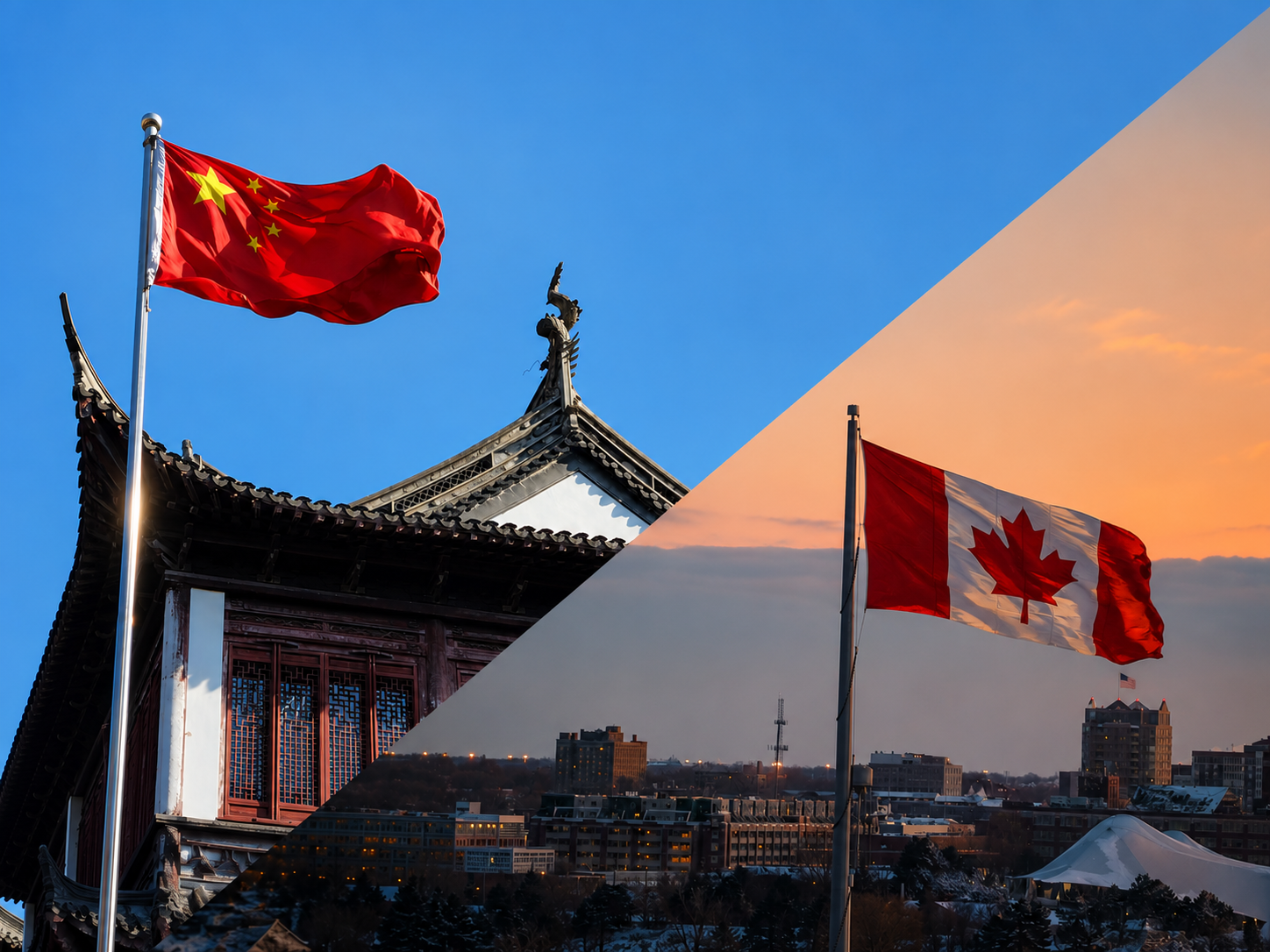
From May 28 to 30, 2026, China’s top diplomat Wang Yi paid an official visit to Canada. During his time in Ottawa, he met with his counterpart Anita Anand and with Prime Minister Mark Carney, who just visited China in January this year. Not only is this the first visit by a Chinese Foreign Minister since 2016, but it is also widely viewed by international observers as a first step in implementing the new Canada-China strategic partnership jointly announced by Carney and Xi a few months ago. Many analysts see Wang Yi’s visit as a reset to the bilateral relationship, which remained strained since the 2018 Meng Wenzhou affair and the subsequent detention of Michael Kovrig and Michael Spavor.
This article compares the Chinese Ministry of Foreign Affairs (MFA)’s official readouts of Wang Yi’s visit with two analyses published by Chinese policy-relevant scholars, revealing how China publicly interprets Canada’s approach toward it, including what Beijing sees as the main drivers of the relationship, the constraints on Canadian policy, and the opportunity Ottawa has to pivot.
The Ministry of Foreign Affairs’ readouts of Wang Yi’s meetings with Prime Minister Mark Carney and Foreign Minister Anita Anand suggest that Beijing is striving for more stable and predictable relations between the countries. The statements repeatedly stress dialogue, mutual respect, and the need to manage differences properly, while placing particular emphasis on restoring practical cooperation in areas such as trade and economic exchange. Rather than signaling a major change in China’s policy toward Canada, the readouts point to a continued focus on stabilizing the relationship through practical engagement.
Beyond the official statements, two Chinese media outlets published analyses by scholars specializing in international relations. Taken together, their commentaries provide useful insight into how policy-relevant Chinese experts are interpreting recent developments in Ottawa.
One of the scholars, who was not named in the byline, is a Professor at the School of Global and Area Studies, University of Chinese Academy of Social Sciences, and a Research Fellow at the Institute of American Studies, Chinese Academy of Social Sciences (CASS). This institution is among China’s most prestigious state-run research organizations in the social sciences. While CASS experts do not formally develop policies addressing China-Canada’s relations, they play an important advisory and epistemic role by producing research, policy analysis, and strategic assessments that can inform and shape how policymakers understand and approach them. The article first published by China Newsweek on June 3, is titled “What Is the Deeper Significance of Wang Yi’s First Visit to Canada in 10 Years?” China Newsweek is a national state-affiliated current affairs magazine under China News Service, reflecting mainstream and policy-relevant discourse within China’s official media system.
The other scholar is Dan Liu, Research Fellow at the Canada Studies Center, Institute of Area and Country Studies, Guangdong University of Foreign Studies. Founded in 1989, this institution was a pioneer in Canadian studies in China and remains one of the few centres dedicated to research on Canada. Her views were published on May 30, 2026 in an interview with Southern Metropolis Daily, a regional state-affiliated newspaper under Guangdong’s Nanfang Media Group, historically known for comparatively investigative and socially oriented reporting within the constraints of China’s party-state media system. Liu is a well-recognized Chinese scholar specializing in Canada and China–Canada relations and is frequently invited by Chinese media to comment on developments involving Canada. The article is titled “Ten Years Later, China’s Foreign Minister Visits Canada Again! Expert: The Timing Is Highly Strategic, Sending These Signals.”
Analytical comparison: official messaging vs. scholarly interpretation
A comparison of the MFA readouts and the two scholarly commentaries shows a striking degree of overlap in how they describe Canada’s approach to China-Canada relations policy. This does not necessarily mean that the scholars are repeating official talking points. Rather, it suggests that both official and policy-relevant discourse are drawing on a similar understanding of Canada’s position.
The relationship between pragmatism and economic cooperation is the clearest area of overlap between the official readouts and the scholars’ commentaries. The MFA readouts emphasize restoring practical cooperation and expanding engagement in areas such as trade and economic exchange. Both scholars interpret this emphasis as a broader shift in the Carney government’s approach. They argue that it places greater weight on economic interests than on ideological positioning, particularly when compared with the Trudeau government. They further contend that Canada’s interest in trade diversification and economic growth provides the main incentive for improving relations with China. Taken as a whole, the official and scholarly narratives suggest that Beijing understands Canada’s recent pragmatism primarily through the lens of economic engagement, with closer commercial ties serving as the main expression of this more pragmatic approach.
The second area of overlap is the role of the United States. The MFA statements do not dwell on third-party influence, but the scholars explicitly point to U.S. pressure as an important factor shaping Canada’s policy for relations with China. Although they differ in how much emphasis they place on this issue, both analyses suggest that Canada’s policy options are constrained by its broader strategic and economic relationship with the United States.
Viewed together, the official readouts and the scholarly assessments point to a relatively consistent Chinese interpretation of Canada’s policy. Both emphasize economic pragmatism and external constraints, and neither presents the Carney government as a fundamental break with the past. Instead, the change is portrayed as an adjustment within a broader pattern of Canadian responses to shifting domestic and international conditions.
In that sense, Chinese officials and scholars both interpret changes in Canadian leadership less as major policy transformations and more as cyclical shifts taking place within a set of enduring constraints.
This is an anonymous submission from a participant in the Tessera Research Collective. The views expressed are the author’s own and do not necessarily reflect those of the Collective or its members.