Canada’s proposed Arctic mineral corridors need clear plans for buyers, domestic processing, and Inuit benefits.
By Kaylee Mak, Research Associate
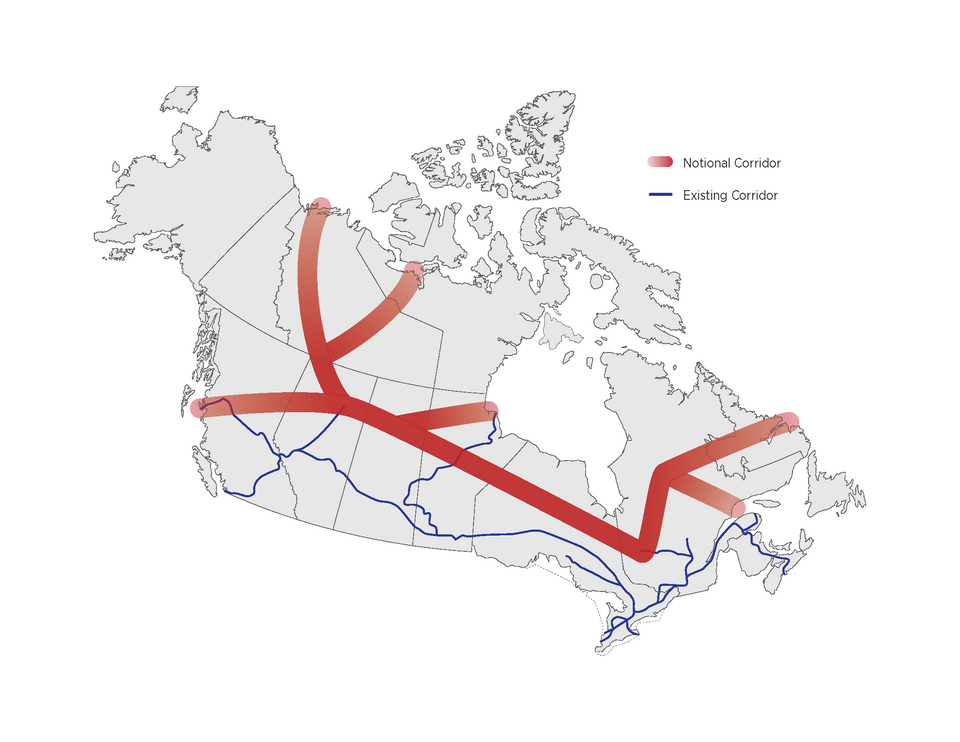
In March 2026, Canada referred the Grays Bay Road and Port and the Arctic Economic and Security Corridor to the Major Projects Office. They consist of a 230 km all-season road from the Nunavut border to Grays Bay and a 400 km all-season road through the Slave Geological Province to the Nunavut border. Both are proposed infrastructure projects with potential civilian and military uses, intended to support Canada’s mining activities and exports.
However, their national-security rationale also calls for public scrutiny of who owns the deposits the corridors would serve. The Izok Corridor project holds one of the world’s largest undeveloped zinc deposits and belongs to MMG Ltd., whose major shareholder is the Chinese state-owned China Minmetals. Building these new corridors could reduce an infrastructure barrier that has kept these deposits underground. By MMG’s own account, the absence of supporting infrastructure has kept these resources undeveloped. Without adequate scrutiny of ownership and domestic benefits, these infrastructure investments could pose security risks and fall short of their economic promise.
The other existing economic viability challenge to the Northern corridors is the limited seasonal accessibility that results from Arctic sea ice. To answer these challenges, Canada could seek investment in domestic smelting and refining and strengthen the Kitikmeot Inuit Association’s existing role as an equity holder in the Grays Bay project.
The commercial case for mineral-export infrastructure depends on attracting businesses and investment. Historically, there have been several calls for Canada to expand corridors to the North to connect with its Northern ports. The Port of Churchill, connected to the Hudson Bay Railway, offers a cautionary example. The Churchill port has historically operated for around four to five months a year, and its rail link requires substantial maintenance. A 2025 policy analysis concludes the port shows little promise of emerging as a robust export artery for Canadian grains, critical minerals, oil, or natural gas. It was once a major seasonal port for exporting grain, but the analysis described it as operating below its planned capacity, with a limited number of community and mineral shipments. It resumed grain shipments in 2026 for the first time in six years.
Compared to year-round ports on Canada’s Pacific and Atlantic coasts, such as those in British Columbia and Nova Scotia, seasonal ports often struggle to compete for the export of general goods like grain and energy. Similarly, the Grays Bay Road and Port project and the Arctic Economic and Security Corridor are proposed as all-season road connections that together would reach a new deepwater port at Grays Bay, Nunavut, to enable natural resource transportation and regional economic development, and potentially support national defence operations. However, one policy critique argues that the proposed northern corridors would be built primarily for unlocking access to specific regional mineral deposits, rather than becoming national export trade routes that drive broader economic growth.
Canada holds substantial resources of critical minerals in the North. Izok, High Lake, Mary River, Pine Point, and Nechalacho are among the region’s major mineral deposits. Within these deposits, MMG has reported roughly 15 million tonnes of mineral resources at Izok Lake, grading 13% zinc and 2.3% copper, and roughly 14 million tonnes at High Lake, grading 3.8% zinc and 2.5% copper. These two deposits also carry other in-demand metals such as lead and silver. While the corridor projects are primarily Indigenous and Canadian held, two of the corridor’s key deposits are controlled by MMG. As of June 2025, China Minmetals indirectly held 67.43 percent of MMG. State involvement in financing mineral corridors is also evident in Africa.
Two examples are the Lobito Corridor railroad system, which connects to the Atlantic through Angola, and the TAZARA railway, which connects to the Indian Ocean through Tanzania. Lobito is heavily backed by Western governments and a US$1.6 billion program co-financed by the African Development Bank. TAZARA is backed by the Chinese government. These corridors connect the mineral-producing regions of the Democratic Republic of the Congo (DRC) and Zambia to maritime gateways in Angola and Tanzania. They illustrate the importance of identifying users and funders for export infrastructure. Canada should likewise make clear how intended end-users and commercial viability will underpin its two proposed corridors.
One common belief about the economic benefits is that the shipping routes in Canada’s Northwest Passage are becoming more accessible. However, research shows that multi-year ice from high-latitude regions forms choke points along some sections of the Northwest Passage, reducing overall shipping season length. The study identifies choke points with short shipping seasons, including on the southern route used by 97% of ships transiting the Northwest Passage.
In Canada, the refining facilities are largely concentrated in the south, spread across several locations – Fort Saskatchewan, Sudbury, Long Harbour, Port Colborne, and some other smaller sites in Ontario, Quebec and Newfoundland and Labrador. Most of these process nickel and cobalt rather than copper. Copper concentrate is ore that has been processed to raise its copper content before smelting and refining. In terms of extraction, Canada was the 12th largest copper producer in 2024. In 2024, Canada exported ores and concentrates containing 348,211 tonnes of copper, a volume equivalent to approximately 68% of its 514,582 tonnes of mined copper production. China and Japan were the principal destinations. These export figures measure copper content, rather than the total weight of concentrate. Domestically, Canada has only one primary copper smelter and one refinery in Quebec and two smaller sites in Ontario and Newfoundland and Labrador that produce refined copper as a byproduct of processing other metals.
More significantly, the historical resource estimates reproduced in MMG’s November 2025 report imply approximately 695,000 tonnes of combined contained copper across Izok Lake and High Lake. These include both indicated and inferred resources and should not be treated as economically recoverable reserves or annual production:
Izok: (14.6 million tonnes of indicated resources + 0.6 million tonnes of inferred resources) × 2.3% copper = approximately 349,600 tonnes of contained copper.
High Lake: (7.9 million tonnes of indicated resources × 3.0% copper) + (6.0 million tonnes of inferred resources × 1.8% copper) = approximately 345,000 tonnes of contained copper.
These figures point to strong potential for Canadian critical minerals in the North. They sit alongside an existing national pattern: Canada sends most of its refined copper exports to the U.S. market, while China and Japan are the principal destinations for its copper concentrate exports. This is a matter of scale, not just process. MMG’s 2012 proposal envisaged a port capable of shipping up to 650,000 tonnes of concentrate a year from the Izok Corridor project. This concentrate tonnage is not directly comparable with national export statistics expressed in tonnes of contained copper. Without accompanying processing investment, new export corridors would not by themselves expand Canada’s smelting and refining capacity.
In 2024, the reported value of Canadian corporate mining assets in Africa grew by 12.1% to reach $45.9 billion, even as their reported asset values at home fell by 3.7% over the same year. These are changes in asset values, which can reflect exchange rates and corporate transactions as well as investment; they do not establish that capital is being redirected from Canada to Africa.
Canadian companies nevertheless participate in major African processing projects. The Kamoa-Kakula joint venture built a 500,000-tonne-per-year copper smelter in the DRC, with first anode production in December 2025. The project is owned 39.6% by Ivanhoe Mines and 39.6% by Zijin Mining, with the DRC government and another shareholder holding the remainder. In Zambia, First Quantum’s 2022 expansion plan aimed to increase the existing Kansanshi smelter’s capacity to more than 400,000 tonnes of copper anode annually.
The building of the Arctic infrastructure needs more consideration of economic viability and national security. While the limited seasonal accessibility undermines the potential economic benefits, foreign state-linked control of critical mineral deposits can raise national security concerns. Despite the rich resources of critical minerals in the Arctic, the examples of Canadian participation in copper smelters in the DRC and Zambia raise a question about the potential for further processing at home. To ensure economic sustainability, Ottawa could consider taking the following actions:
Use offtake commitments from buyers in Critical Minerals Production Alliance partner countries to support financing for Northern processing capacity. In February 2025, Greenland Resources signed a ten-year molybdenum offtake agreement with Outokumpu of Finland. Separately, in March 2026, the company received conditional approval for up to CAD$7 million in research funding from the Canadian government for its Malmbjerg project in Greenland. A similar offtake-based approach could work for mining companies that may one day operate in Canada’s North. In March 2026, Canada announced that Frontier Lithium had signed a memorandum of understanding with Panasonic Energy of Japan for potential future lithium offtake from its proposed refinery in Thunder Bay, Ontario. When a project is marketed and developed properly, Canada could attract genuine buyers for its minerals.
Create federal incentives for private-sector Canadian mining companies to build smelting and refining facilities in the North where feasibility studies demonstrate sufficient feedstock, reliable and affordable power, and viable operating and transport costs. This could encourage Canadian firms to build at home what they have already built abroad.
Require disclosure of deposit ownership, a commitment to process minerals in Canada, and a durable Inuit equity stake agreement in the corridor as a condition for public infrastructure funding. The proponent of the Grays Bay Road project is the West Kitikmeot Resources Corporation, founded in partnership between the Kitikmeot Inuit Association and private investors. This is an exemplary model of community ownership that should be replicated to achieve local beneficiation.
Together, these measures could help turn the Northern corridors from routes for exporting concentrates into viable economic links that retain more processing activity and economic benefits in Canada.
The views expressed in this article are the author’s own and do not necessarily reflect those of Tessera Institute for Global Affairs.
References
African Development Bank Group. “African Development Bank Joins Global Partners to Raise Financing for $1.6 bn Multinational Lobito Transportation Corridor Programme.” 2024. Read the source.
bne IntelliNews. “China Signs $1.4bn Tazara Railway Deal, Reviving Copperbelt Link amid Lobito Corridor Rivalry.” September 29, 2025. Read the source.
Canadian Broadcasting Corporation. “Grain Being Shipped Out of Port of Churchill for 1st Time in 6 Years.” August 2026. Read the source.
Cook, Alison J., Jackie Dawson, Stephen E. L. Howell, Jean E. Holloway, and Mike Brady. “Sea Ice Choke Points Reduce the Length of the Shipping Season in the Northwest Passage.” Communications Earth & Environment 5, article 362 (2024). Read the source.
European Commission, Directorate-General for International Partnerships. “Lobito Corridor: Building the Future Together.” Accessed September 18, 2026. Read the source.
Exner-Pirot, Heather. “Northern Corridors: Hype or Hope?” Macdonald-Laurier Institute, April 14, 2025. Read the source.
First Quantum Minerals. “First Quantum Announces Board Approval of the Kansanshi S3 Expansion and Enterprise Nickel Project.” Press release, May 8, 2022. Read the source.
Greenland Resources. “Greenland Resources Signs Ten Year Off-Take Agreement With Outokumpu to Supply High Quality Molybdenum.” February 24, 2025. Read the source.
Ivanhoe Mines. “Ivanhoe Mines Announces First Anode Production from Kamoa-Kakula Copper Smelter.” January 2, 2026. Read the source.
Ivanhoe Mines. “Kamoa-Kakula Copper Complex.” Accessed October 5, 2026. Read the source.
Lasley, Shane. “Nation- and Mine-Building in Nunavut.” North of 60 Mining News, January 14, 2026. Read the source.
Major Projects Office, Government of Canada. “Arctic Economic and Security Corridor (AESC).” Accessed September 18, 2026. Read the source.
Major Projects Office, Government of Canada. “Grays Bay Road and Port.” Accessed September 18, 2026. Read the source.
MMG Limited. Interim Report 2025, 31. Hong Kong Stock Exchange, September 2025 [PDF]. Read the source.
MMG Limited. Public Report of Exploration Results for Izok. November 2025 [PDF]. Read the source.
MMG Limited. “Grays Bay Road and Port: A Game Changer for Nunavut and Izok Corridor.” Accessed September 18, 2026. Read the source.
MMG Limited. “Izok Corridor Project Proposal Submitted.” September 4, 2012. Read the source.
Natural Resources Canada. “Canada Secures 30 New Critical Minerals Partnerships and Unlocks $12.1 Billion in Mining Project Capital.” Backgrounder. Government of Canada, March 2, 2026. Read the source.
Natural Resources Canada. “Canadian Mining Assets.” Accessed September 18, 2026. Read the source.
Natural Resources Canada. “Copper Facts.” Accessed September 18, 2026. Read the source.
Prime Minister of Canada. “Prime Minister Carney Announces Ambitious New Plan to Defend, Build, and Transform the North.” March 12, 2026. Read the source.
Statistics Canada. “Canadian Export Classification: Chapter 26, Ores, Slag and Ash.” 2024. Read the source.
Walling, Jackson. “Churchill’s Costly Dream: Why the Port Is Not Fit for Major Exports.” North American and Arctic Defence and Security Network, December 29, 2025 [PDF]. Read the source.