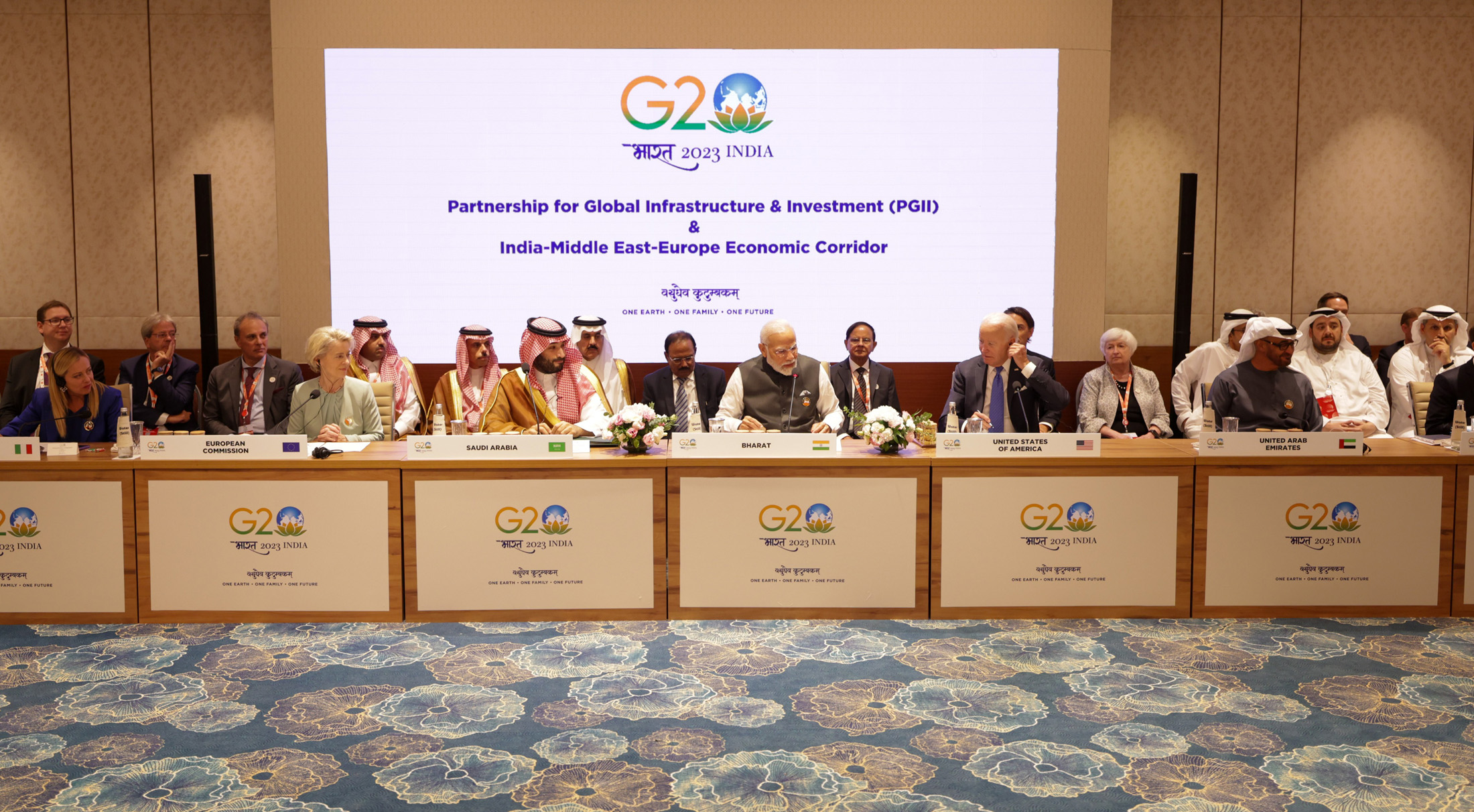
Photo: PM addresses at the Partnership for Global Infrastructure and Investment & India-Middle East-Europe Economics Corridor event during G20Summit, in New Delhi on September 09, 2023. Source: Prime Minister’s Office, Government of India, via Wikimedia Commons, licensed under GODL-India.
Analytical brief by Lakshya Rohilla
YPP Research Analyst, Tessera Institute for Global Affairs
Few regions are as crucial to understanding Indian foreign policy and its pursuit of strategic autonomy as West Asia. India has historically approached the region through a cautious balancing strategy shaped partly by domestic political considerations, seeking to maintain relations with competing powers while avoiding dependence on any one of them. However, the past decade has witnessed an expansion of New Delhi’s engagement with the region. Under Prime Minister Narendra Modi, New Delhi has deepened its strategic, economic, and political engagements simultaneously with Israel, Saudi Arabia, the UAE, and Iran, giving greater prominence to multialignment as a means of pursuing strategic autonomy. This development reflects three core factors: the growing importance of West Asia to New Delhi’s trade, connectivity, and energy security; the pursuit of partnerships with competing powers; and India’s ambition of becoming a more influential geopolitical actor in an increasingly multipolar global order.
A key contour of this transformation has been West Asia’s growing strategic importance to India’s economic and trade security and connectivity interests. While the Gulf has long been a major supplier of India’s energy needs, the region has also become increasingly important to New Delhi’s trade, investment, and maritime security. India’s trade with the Gulf Cooperation Council (GCC) reached USD 178.56 billion in FY 2024–25, accounting for 15.42 per cent of its global trade. Additionally, New Delhi’s energy relationship with the Gulf extends beyond crude oil to natural gas, including liquefied natural gas (LNG), and petrochemicals, alongside shared interests in secure maritime routes. On 5 February 2026, India and the GCC signed the terms of reference for free trade agreement negotiations, highlighting their interest in a broader economic partnership extending beyond energy trade. For New Delhi, this also reflects an increasingly comprehensive view of the Gulf’s role in Indian foreign policy, as a long-term strategic and economic partner in an increasingly fragmented global economic order.
New Delhi’s role in the Gulf has expanded from that of an oil consumer to a broader economic and strategic partner, coinciding with a more visible multialigned approach to Indian foreign policy. During the 2026 conflict involving Iran, New Delhi sought to preserve relations with competing regional powers, including Abu Dhabi, Riyadh, and Doha, while maintaining active diplomatic channels with Tehran and close defence ties with Israel. A notable feature of this approach has been the ability to sustain engagement with multiple power centres despite their rivalries. For example, on 19 January 2026, New Delhi and Abu Dhabi signed a letter of intent towards concluding a Strategic Defence Partnership, aiming to deepen defence collaboration. India also pursued safe passage for India-bound vessels through the Strait of Hormuz. However, Iran’s announced arrangements for non-hostile shipping required coordination with Iranian authorities, rather than providing unrestricted access. Moreover, the Modi government has deepened economic, military, and security ties with Israel, while continuing to support a two-state solution and provide aid to Palestine. In February 2018, Modi became the first Indian prime minister to visit Ramallah. Although engagement with competing regional powers predates Modi, his government has expanded and raised the diplomatic visibility of these relationships, pursuing Indian interests through simultaneous substantive engagement with rival powers and blocs.
Apart from diversifying energy supplies, trade routes, and supply chains, New Delhi’s rationale for adopting a multialigned regional approach stems from its ambition to become a more influential geopolitical actor. India’s engagement with West Asia reflects the growing confidence of a nation that seeks to shape regional developments and outcomes, rather than simply respond to them. New Delhi’s economic growth, expanding military capabilities, and more assertive foreign policy have strengthened its international position. India remains among the fastest-growing major economies, although the World Bank’s April 2026 outlook also identifies risks from higher energy prices and supply-chain disruptions caused by the Middle East conflict. As one of the world’s largest economies, an emerging military power, and a prominent voice of the Global South, New Delhi possesses greater diplomatic and economic leverage than it did a decade ago.
The changing global and regional balance of power is reflected in New Delhi’s efforts to position itself as an increasingly important strategic partner for several major regional actors. Initiatives such as I2U2, comprising India, Israel, the UAE, and the United States, and the proposed India–Middle East–Europe Economic Corridor (IMEC), alongside expanding military and security cooperation, maritime security partnerships, and connectivity projects, demonstrate New Delhi’s ambition to help shape the region’s economic and strategic outlook. These initiatives indicate diplomatic ambition, although participation and announcements alone do not establish India’s influence over regional outcomes. The willingness of competing states, including Israel, Iran, and Gulf partners such as the UAE, Saudi Arabia, and Oman, to maintain or deepen engagement with New Delhi suggests that they see value in its economic and diplomatic partnerships. India seeks to sustain these relationships while preserving its independence and limiting the effects of regional rivalries on its interests.
Nevertheless, questions and gaps persist in the Modi government’s approach towards West Asia. There is a case for closer coordination with GCC governments in responding to Iranian air and drone strikes, given the risks to the Indian diaspora and the scale of India’s economic interests in the Gulf. Yet maintaining diplomatic access to Tehran also has practical value, including for maritime security. The government must therefore consider when strategic autonomy calls for more differentiated responses in accordance with India’s interests and security concerns. Maintaining relations with rival governments does not, by itself, enable New Delhi to prevent disruptions or guarantee the safety of its citizens. The challenge is to translate diplomatic access into practical protection and influence without unnecessarily closing channels of engagement.
While challenges persist, including the deaths of Indian sailors in the Iran conflict and the implications of the Saudi–Pakistan defence agreement, India has broadened its partnerships across West Asia. Regional instability, questions surrounding longstanding American security guarantees, and disruptions to global supply chains reinforce the importance of diversified partnerships, alternative trade routes, and connectivity corridors, even as they complicate their development. As the global order becomes increasingly multipolar and fragmented, and established international rules face mounting challenges, West Asia is likely to remain central to India’s ambition to become a more influential regional and global actor. The value of multialignment will depend on how effectively India can use these partnerships to protect its interests amid competing regional demands.
The views expressed in this article are solely those of the author and do not necessarily reflect those of the Tessera Institute for Global Affairs.
Bibliography
Kaul, Aditya Raj. 11 June 2026. Indian Sailors Killed in Attack Near Strait of Hormuz, Spark Safety Concerns. NDTV.
Ministry of External Affairs, Government of India. 19 January 2026. Joint Statement: Visit of President of the UAE, His Highness Sheikh Mohamed bin Zayed Al Nahyan to India.
Ministry of External Affairs, Government of India. 26 February 2026. India–Israel Joint Statement.
Press Information Bureau, Government of India. 5 February 2026. India and Gulf Cooperation Council Sign Terms of Reference for India–GCC Free Trade Agreement. Ministry of Commerce and Industry.
Representative Office of India, Ramallah. n.d. India–Palestine Relations.
Reuters. 24 March 2026. Iran Tells UN: ‘Non-hostile’ Ships Can Transit Strait of Hormuz.
Taneja, Kabir, ed. November 2025. The Saudi Arabia-Pakistan Defence Agreement: Perspectives from India and the Middle East. ORF Special Report No. 287. Observer Research Foundation.
World Bank. 9 April 2026. India Remains Among the Fastest-Growing Economies Even As Growth Slows Amid Middle East Conflict; Outlook Vulnerable to Risks and Uncertainty.